The heartbreaking story of Lila Marsland

There are kids that brighten the space as soon as they enter. One of them was Lila Marsland, who was five years old, lively, quick to laugh, and incredibly loved.

She was showing off her new bike with pride, still feeling the post-Christmas high that came with starting school. Her joy should have been her legacy.
Rather, she gained notoriety for a tragic cause that no child should ever experience: avoidable medical negligence.

Neck pain and vomiting
Lila had a family stroll close to the picturesque Dovestone Reservoir in Greater Manchester on December 27, 2023. An enjoyable outing swiftly devolved into a nightmare. She started to complain about having a headache. She puked on the way back to the car. Her symptoms intensified later that day; she started to feel drowsy and experienced neck ache.
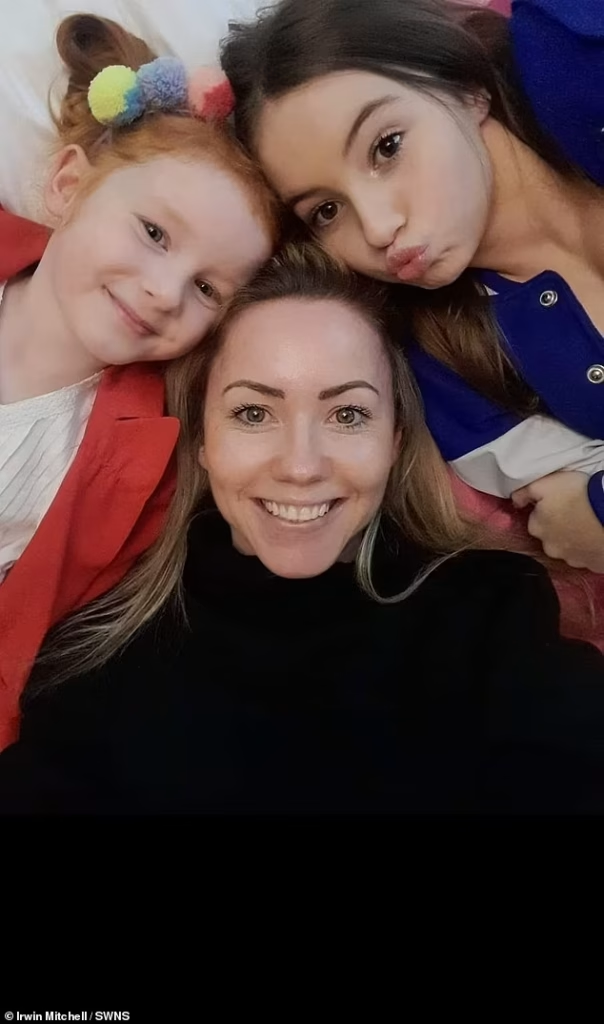
Rachael Mincherton, her 36-year-old mother, became worried right away. She suspected something far more dangerous than a virus because she was a district nurse at Tameside General institution, the same institution where she took Lila.

Rachael had expressed her worries regarding meningitis, pointing out that kids usually don’t complain of neck ache unless they have a very good reason for it. She was unable to disregard the warning sign.
A nurse practitioner, a junior physician, and a senior pediatric registrar were among the medical personnel who saw Lila, but she was released from the hospital shortly after 2:30 a.m. with a suspected case of tonsillitis. According to her mother, she trusted them. She collaborated with them. She never thought they would be mistaken.

“To be honest, I felt reassured by them,” Rachael told the BBC. Before this, she had a number of infections, but she always got fantastic treatment. That hospital was where I worked. When you work with others, you don’t actually lack trust in them.
The following morning, that confidence was broken.
“I was aware that she had passed away a long time ago.”

Rachael discovered Lila unconscious in bed at approximately nine in the morning on December 28.
She waited for paramedics after calling 999 and performing CPR. However, it was too late. Hours after being taken home, her daughter had passed away.
Rachael remarked, “I knew she had been dead for a long time.” “The paramedics showed up in five minutes, but they were powerless to help.”
Rachael’s first dread was validated by a post-mortem: Lila had pneumococcal meningitis, which ultimately contributed to her death.
The ensuing inquest presented a heartbreaking picture of systematic shortcomings and lost chances. The jury came to the conclusion that Lila’s death may have been avoided and that neglect was a contributing factor.
According to the jury’s statement, Lila would not have died if she had been taken to the hospital and administered broad spectrum antibiotics within the first hour of being triaged.
Darren Marsland, the father of Rachael and Lila, waited for answers for 17 months. The term they had feared became official when the inquest was finally over: neglect.
“A parent should never have to hear the word ‘neglect,'” Rachael stated outside the courtroom, as reported by Manchester Evening News. “For the rest of our lives, we must live with the terrible loss of our daughter.”
“We have never been apologized to.”
Why is it even more difficult? At least not explicitly, the apology never materialized.
In June of 2025, Rachael told the BBC, “We’ve never received an apology.” “We first noticed it on the news following the inquest.”
The hospital trust said in a statement that it accepted the coroner’s conclusions, apologized for “missed opportunities,” and promised to enhance care.
However, the harm to Lila’s family is irreversible.
https://www.facebook.com/photo/?fbid=4374560926117780&set=a.3062816317292254Rachael remembered that she was always joyful. Everyone would chuckle at her. She was simply a unique young child.
She was loved by her 15-year-old big sister, Ava. They couldn’t be separated.
Rachael remarked, “She simply loved her life and was a pleasure to parent.” “She enjoyed going to school and hanging out with her friends.”
raised more than $24,000.

The Marslands are now operating a charity in her honor rather than sending her to school.
As a tiny way to support youngsters in expressing their grief in a society that frequently doesn’t inquire about their well-being, they founded Lila’s Light, a nonprofit organization that provides “bereavement bags” to siblings of deceased children.

“What they are writing and drawing helps the parents understand their grief,” Darren said. “Many kids don’t express themselves verbally, but they will write it down.”
In addition to raising over $24,000, they have distributed the backpacks to over 15 hospitals. In Lila’s memory, Darren and his companions even scaled Ben Nevis.

Beyond awareness and transformation, however, what they truly desire is the return of their young girl.
“Really, you’re just surviving,” Rachael remarked. “There are numerous “what-ifs.” What if we had transported her to a different medical facility? There are many different kinds.

Instead of being remembered for what was taken from her, Lila Marsland should be remembered for her love of life. She ought to still be here, riding her bike, playing with her sister, and illuminating every space she entered.

Rather, her name has become a rallying cry because she shouldn’t have had to be famous, not because she was.


