Breakthrough as cheap medicine taken by millions is found to fight off the most deadly form of breast cancer

Breakthrough: Millions of people are using inexpensive medication to prevent the most dangerous type of breast cancer.
According to recent research, a low-cost blood pressure medication that millions of people already take may help shield women from one of the most deadly types of breast cancer.

According to researchers at Melbourne’s Monash University, beta blockers, which reduce the impact of stress hormones, may also help certain patients with triple negative breast cancer stop the disease’s growth.
It remained unclear why the association between beta blockers and breast cancer first surfaced in 2023.

Researchers think they have finally figured out the process, and with it, a possible low-cost cure for a very aggressive illness.
Their research examined how two signalling molecules, calcium and cAMP, interact to speed up the progression of cancer when a receptor known as the beta-2 adrenoceptor is triggered.
This receptor can be activated by stress hormones like cortisol, which promotes the growth of tumours.
However, the research has recently shown that beta blockers can reduce the disease’s progression by turning off the HOXC12 gene, which is responsible for this process.
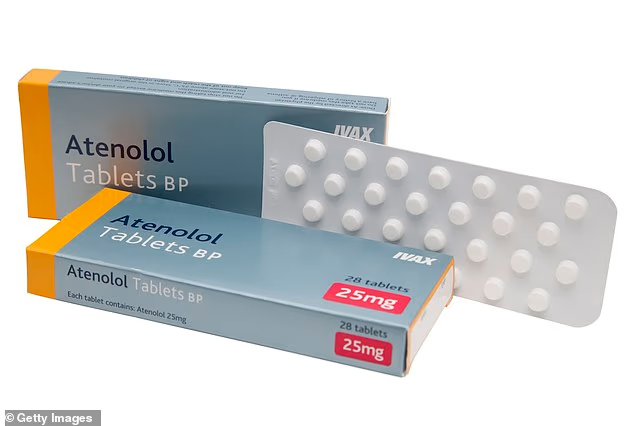
The discovery, according to the researchers, may make it easier for medical professionals to determine which patients are most likely to benefit from beta blocker therapy at the time of diagnosis.
The study’s principal author, Professor Michelle Halls, a specialist in drug discovery biology at the Monash Institute of Pharmaceutical Sciences, described the results as encouraging since they validated a possible connection between beta blockers and the development of tumours.
According to earlier research by our colleagues, beta blockers significantly lower the death rate for patients with triple negative breast cancer.

“We now understand why this might be the case much better,” she said.
“Our combined research strongly suggests that HOXC12 is a potential new indicator for when triple negative breast cancer patients could respond to beta blocker targeted interventions,” said Mr. Terrance Lam, a pharmaceutical PhD candidate at the centre and study co-author.
Finding new therapeutic avenues is crucial since triple negative breast cancer is an aggressive malignancy that might be particularly difficult to cure.

In order to “urgently” ascertain if the gene can be utilised at diagnosis to identify patients who will benefit from beta blocker therapy – and prevent their disease from spreading – the researchers are now urging more research.
Often recommended to decrease blood pressure, beta blockers primarily slow the heart and prevent stress chemicals like adrenaline from doing their job.
The study, which was published in the scientific journal Science Signalling, found a substantial link between faster cancer progression and beta-2 adrenoceptor activation.

Additionally, they discovered that individuals with elevated HOXC12 expression were linked to worse overall results for cancer survival.
Breast cancer is the most frequent cancer in the UK, with one in seven women receiving a diagnosis at some point in their lives (about 56,000 annually).

Approximately 85% of women with breast cancer go on to live for more than five years after receiving their diagnosis.
Treatment for triple negative breast cancer, which makes up around 15% of all breast cancers in the US and the UK, is far more difficult.

It usually has fewer treatment options and develops and spreads more quickly than other forms of breast cancer.
One explanation for this is that, unlike other breast cancers for which targeted medicines are available, it does not interact with hormones like oestrogen in the same manner.

Approximately 77% of women with triple negative breast cancer will live with their disease for five years or longer on average after receiving a diagnosis, though this might drop as low as 12% depending on the stage.

About 90% of women with other types of breast cancer will live for at least five years, in contrast to this.


