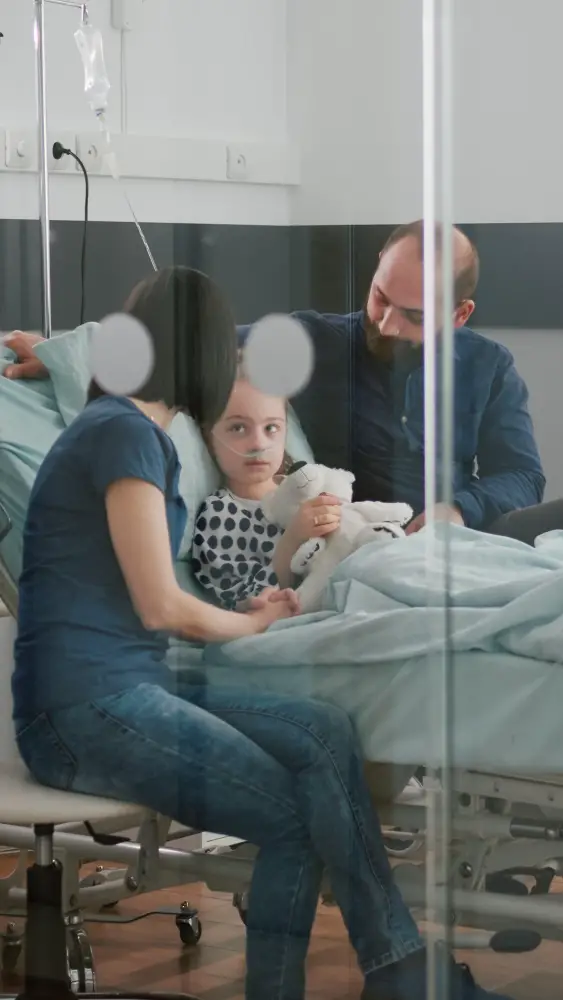
A Mysterious Visitor Revealed What Her Late Husband Had Left Behind

The nurse handed me a plastic bag with my husband’s name written on it in black marker.
JACK MORGAN. ROOM 412.
That was all that was left of him in that building. A bag. A name. A room number that probably already belonged to someone else.

“I’m so sorry it took us this long,” she said. Her name tag said RACHEL. She had been on the night shift most of Jack’s last month, and she was the one who used to bring him extra pudding cups even though he couldn’t eat them. “Things got mixed up after he passed. It was in the
wrong storage room.”
“It’s fine,” I said.
It wasn’t fine. Nothing had been fine for a long time. But it was a week after the funeral, I was six
months pregnant, and I had learned that “it’s fine” was the fastest way to get out of any conversation.
I opened the bag right there at the nurses’ station because I didn’t trust myself to open it at
home.
His watch. The cheap black one he refused to replace because “it still tells time, Claire, that’s the whole job.” His phone charger, the cord bent at the end where he always wrapped it too tight. His
toothbrush and deodorant in a ziplock bag. A paperback thriller with the corner of page 211 folded down. He never finished it.
And underneath all of that, folded neatly, was a gray cardigan.
A woman’s cardigan. Soft, a little worn at the elbows. It smelled faintly like vanilla.
I didn’t own anything that smelled like vanilla.
I held it up. “This isn’t mine.”
Rachel looked at it and her face changed. Just a little. Just enough.
“Oh,” she said. “I think that might belong to the woman who visited him.”
I kept holding the cardigan in the air like an idiot. “What woman?”
“Dark hair. Early forties, maybe? She came in several times. I thought—” She stopped. “I’m sorry. I assumed she was a relative.”
“Jack didn’t have family,” I said.
“I know. He told me that once.” Rachel’s voice got quieter. “But she’d sit with him for a long time. They always had papers everywhere. I figured she was helping with paperwork, insurance, something like that.”
I knew every person who helped Jack with paperwork. Because it was me. It was always me.
“How many times?” I asked.
“Mrs. Morgan—”
“How many times did she come?”
Rachel glanced toward the hallway, like she wished someone would call her away. “I don’t know exactly. Four? Five? Usually in the afternoons.”
In the afternoons. When I was at prenatal appointments. When I was picking up Lucy from preschool. When I was on hold with the insurance company for the third time that week.
I folded the cardigan back into the bag. My hands were completely steady. That scared me more
than if they’d been shaking.
“Thank you,” I said.
I walked out to the parking garage, got into my car, and put the bag on the passenger seat.
Then I sat there for forty minutes without turning the engine on.
To understand why that cardigan felt like someone had kicked out the floor under me, you have to understand two things.
The first is that my life was lists.
I’m not exaggerating. I had a list for Jack’s medications, with times and doses and which ones made him sick if he didn’t eat first. I had a list for oncology appointments. A list of insurance
claim numbers, with the name of every person I’d spoken to and what they promised. A list of bills, color-coded by how much trouble we’d be in if I paid them late. A list for Lucy’s preschool: spirit day, picture day, bring a snack on Thursday. A list for my prenatal appointments, because
being pregnant with your second child while your husband has cancer does not mean you get to skip the glucose test.
I had a list of my lists. That one was on the fridge.
The second thing is that I had been with Jack Morgan since I was sixteen years old.
He sat behind me in junior year chemistry. On the second day of school he tapped my shoulder
and asked if he could borrow a pencil. I gave him one. He never gave it back. The next day he asked for another one.
“What happened to the first pencil?” I asked.
“It’s in a better place now.”
“You lost it.”
“I’m choosing to believe it’s on a journey.”

I gave him the second pencil anyway. By Christmas I had given him eleven pencils, and he had given me a ride home every day in a truck with no working heat, and I knew I was in trouble.
We got married at twenty-three. Lucy came when I was thirty-one. She has his dark eyes and my
inability to sit still. She was four when Jack got sick, and she believed with her whole heart that Daddy was going to get better.
Why wouldn’t she? Daddy told her so.
“The medicine is like tiny superheroes,” he told her one night, sitting on the edge of her bed with a blanket over his own shoulders because he was always cold by then. “They go into my body and fight the bad guys.”
“Are they winning?” Lucy asked.
“They’re very brave.”
“That’s not what I asked.”
He laughed so hard he started coughing. “She’s yours,” he told me over her head. “That one is a hundred percent yours.”
People who saw us from the outside used to say we balanced each other. That’s a nice way of saying I organized and Jack joked.
When the diagnosis came, I bought a binder. A big one, three inches thick, with tabs. Jack
watched me label the tabs at the kitchen table.
“You know you don’t have to control every second of this,” he said.
I didn’t look up. “Which part should I stop controlling?”
“Maybe start with me.”
“You’re the least trustworthy one.”
He put his hand over his heart like I’d shot him. “We’ve been together since high school.”
“Exactly. I have evidence.”
“You’re terrifying.”
“Good.” I snapped the binder shut. “Cancer should be terrified of me.”
He looked at me then, really looked, and something in his face went soft. He reached across the table and took the label maker out of my hand.
“Claire.”
“I’m busy.”
“I know. Come here for a second.”
I didn’t want to. I had seventeen more tabs to label. But I went around the table and he pulled me down onto his lap, which he wasn’t supposed to do because of my belly and his port, and he put his face against my neck and just breathed.
“We’re going to be okay,” he said.
“You don’t know that.”
“No,” he said. “But you’re going to make a binder about it, so I feel pretty good.”
I laughed. I remember that I laughed. I’ve thought about that night a lot since, because it was one of the last times I remember us being on the same side of something without any secrets between us.
Or at least, I thought there were no secrets.
It started small. That’s how it always starts, I guess.
Jack would disappear.
Not for days. For hours. By then he was so weak that a trip to the mailbox left him sitting on the porch steps for ten minutes catching his breath. But I’d come home from the store or from picking up Lucy and his car would be gone.
The first time, I called him six times. He didn’t pick up. When he finally walked through the door, he was gray in the face and holding on to the wall.
“Where were you?”
“Out.”
“Out where?”
“Just out, Claire.”
“For three hours?”
“I needed air.”
“You can barely walk through Target,” I said. “You needed three hours of air?”
He lowered himself into the recliner very carefully, like he was made of glass. “Can we not do this right now?”
“Do what? Ask where my husband was? You’re not supposed to be driving on these meds, Jack.
You could have killed somebody. You could have killed yourself.”
“I was careful.”
“That’s not the point.”

He closed his eyes. “I know it’s not.”
That was all I got.
It happened again the next week. And the week after. Once I found a folder of papers in the
inside pocket of his jacket when I was taking it to the dry cleaner. Before I could look, he was standing in the doorway.
“I’ll take that,” he said.
“What is it?”
“Boring stuff.”
“Then why can’t I see it?”
“Because it’s boring.” He held out his hand. He was smiling, but his hand was steady and it didn’t drop. I gave him the jacket.
Then there was the laptop.
Jack had never been a computer person. He was a mechanic. He fixed engines with his hands and he thought online banking was a scam invented to make people feel stupid. But suddenly I’d wake up at two in the morning and his side of the bed would be empty, and I’d find him at the kitchen
table with the laptop open and the blue light on his face.
The first night I just stood in the hallway and watched him. He was typing slowly, one finger at a time, frowning at the screen. Every so often he’d stop and rub his eyes.
When I stepped into the kitchen, he closed the laptop.
Not fast. Not like a teenager hiding something. Just calmly, like it was nothing. Which somehow made it worse.
“Can’t sleep?” he said.
“What are you doing?”
“Reading.”
“At two in the morning.”
“Cancer doesn’t keep business hours.”
“Jack.”
“Claire.” He smiled at me. “Please don’t interrogate the dying man.”
It was a joke. He’d been making that joke for weeks. Usually I’d roll my eyes and let it go. But it was two in the morning and I was so tired that my bones hurt, and the baby had been kicking my
ribs all night, and I had a meeting with the insurance company at nine.
“I wish I could,” I said.
The smile slid off his face. “Wish you could what?”
“Interrogate you. Make you tell me what’s going on. I wish I could just open you up and read you like one of my lists.”
He was quiet for a long time.
“You already have enough to carry,” he finally said.
“That’s not your decision.”
“It should be sometimes.”
I sat down across from him. My back hurt. Everything hurt. “What does that mean?”
He turned the laptop around on the table so it faced away from both of us, like he didn’t even want to look at it.
“You know what you’re like,” he said. “You see a problem and you pick it up. Doesn’t matter whose it is. Doesn’t matter how heavy it is. You just pick it up.” He rubbed his thumb along the edge of the table. “If someone needed help tomorrow, you’d forget to ask whether you could afford to
give it.”
“Is that a bad thing?”
“It scares me.”
“Why?”
He looked at me with those dark eyes, the same ones Lucy has.
“Because you never know when to let someone else be the problem.”
I didn’t know what to say. I had a hundred questions, and I could see that he wasn’t going to answer any of them. And I was so tired. And he was so sick. And in my head was this voice saying: He’s dying. Let him have something.
So I did.
I stood up, kissed the top of his head, and went back to bed. I let him keep one corner of his life private.
That was my first regret.
Five weeks later, he was in a hospital bed in room 412 and the doctors had stopped using words like “next round.”
They used words like “comfortable.”
I sat beside him and held his hand. His skin felt thin, like paper. Lucy was at my friend Teresa’s house. I had told her Daddy needed to rest. That was true. It just wasn’t the whole truth. I was

starting to understand how that worked.
Jack opened his eyes and looked at me for a long time.
“You look scared,” he said. His voice was barely a whisper.
“So do you.”
“I’m allowed.”
“So am I.”
That made him smile a little. His thumb moved against the back of my hand. Back and forth, back and forth.
“You’ll be okay,” he said.
“Don’t.”
“Claire. Listen to me.” He squeezed my hand. There was almost nothing in it, but he squeezed. “Promise me you’ll keep going.”
“I don’t know how.”
“You’ll figure it out.” His eyes were already closing. “You always do.”
Those were the last clear words he said to me.
He lived another two days. He mumbled sometimes. Once he said “the boy,” and I thought he meant Lucy and got confused, because she’s a girl. Once he said “sorry, sorry,” over and over, and I told him he had nothing to be sorry for.
I believed that when I said it.
He died on a Tuesday, a little after four in the morning. I was asleep in the chair. Rachel woke me up by touching my shoulder very gently, and I knew before she said anything.
Three days later, I was sitting in a small office at our bank, across from a woman with very neat fingernails and a very careful voice.
I had come in because Jack’s last paycheck had been deposited and I wanted to move some
money around. That’s what I told myself, anyway. Really, I needed to see the numbers. I had been avoiding the numbers for months.
The woman turned her screen toward me.
“I’m so sorry for your loss, Mrs. Morgan,” she said. “I want to make sure you understand where things stand.”
I looked at the screen. Then I looked again.
“That can’t be right.”
“I’m afraid it is.”
There wasn’t enough for next month. Not enough for the mortgage, not enough for the car
payment, not enough for the utilities. And underneath that, a loan. A loan against the house that I had signed during the second round of chemo, when the doctor said there was a new treatment, a trial, a chance.
I remembered signing it. I remembered thinking it didn’t matter, that we’d figure it out after.
Our savings were gone. Every penny of the money we’d been putting away since Lucy was born. Gone.
And three weeks earlier I had sold my jewelry. My grandmother’s pearl earrings. The gold bracelet Jack gave me on our tenth anniversary. My engagement ring, too, though I hadn’t told anyone that. I wore a silver band from the drugstore so Lucy wouldn’t ask questions.
“Mrs. Morgan?” the woman said. “Are you all right?”
“I’m fine,” I said.
She slid a box of tissues toward me anyway. I didn’t take one.
Here’s the thing nobody tells you. When someone you love is dying and a doctor offers one more treatment, you don’t ask whether you can afford hope. You just sign. You sign everything. You’d sign your own name in blood if they asked.
Then hope dies.
And the bills stay.
The funeral was small. Jack really didn’t have family. His parents died in a car accident when he was
nine, and he grew up in the foster system. He never talked about it much. When I asked, he’d say, “It was a long time ago,” or “Some places were okay,” and then he’d change the subject. I learned not to push.
His friends from the garage came. My parents flew in from Arizona. Teresa held Lucy’s hand the whole time because I couldn’t trust mine not to squeeze too hard.
Lucy wore a purple dress because purple was Daddy’s favorite. It wasn’t. His favorite color was green. But she was so sure, and I didn’t have it in me to correct her.
At the cemetery, she tugged on my sleeve.

“Mommy, when is Daddy coming out of the box?”
My mother made a small sound behind me, like she’d been hit.
I knelt down in the wet grass, which I wasn’t supposed to do with my belly, and took both of
Lucy’s hands.
“He’s not coming out, baby.”
“But the medicine superheroes—”
“They tried really hard,” I said. “They were so brave. But the bad guys were too strong.”
She looked at me like I was lying. Maybe she was used to it by then.
“Daddy said they were winning.”
“I know he did.”
“Did Daddy lie?”
I opened my mouth and nothing came out.
Behind me, I heard the casket start to lower.
So that was where I was when Rachel gave me that bag. Broke, pregnant, a widow at thirty-five, with a four-year-old who didn’t believe a word I said.
And now there was a gray cardigan that smelled like vanilla.
I didn’t tell anyone about it. Not my parents, who had gone back to Arizona. Not Teresa. I put it in the back of my closet and tried to forget about it.
That lasted one day.
On the second day, I called the hospital and asked to speak to the head of security.
“I need to see the visitor logs for room 412,” I said.
“I’m sorry, ma’am, we can’t release that kind of information.”
“My husband was the patient. He’s dead. I’m his wife. I have the death certificate. I have power of attorney. I have a binder.”
“A binder?”
“A very big binder.”
They still said no. So I called again the next day. And the next. I called the patient advocate. I
called the hospital’s legal department. I went in person and sat in the lobby with my belly and my binder and my four-year-old eating crackers out of a bag, and I waited.
I think in the end they let me see the footage just to get rid of me.
A tired man named Gerald brought me into a small room full of screens. He pulled up the hallway outside room 412 on one of the dates Rachel had mentioned.
“I can only show you the hallway,” he said. “Not inside the room.”
“That’s fine.”
He pressed play.
And there she was.
She was walking toward Jack’s door, holding a thick folder against her chest. Dark hair pulled back. A gray cardigan. She stopped outside the door and took a breath, the way you do before walking into a job interview, and then she went in.
“How long does she stay?” I asked.
Gerald fast-forwarded. The time stamp at the bottom raced. Nurses blurred past. A food cart. A man with balloons.
The door opened again an hour and fifty-two minutes later.
“Almost two hours,” Gerald said, like I couldn’t read.
“Show me the next day.”
He found it. Same woman, same folder. This time, when she came out of the room, she walked about ten feet down the hall and then stopped and put her hand over her mouth.
She was crying.
Not a little. Her shoulders were shaking. A nurse walked past and touched her arm, and she nodded and waved her off, and then she stood alone in that hallway for a long time, crying into her hand.
I watched it four times.
“Did you notice anybody else with her?” I asked.
Gerald checked. “No, ma’am. Mostly alone. Every time.”
Mostly alone. Every time.
I thanked him. I walked out to my car. Lucy fell asleep in her car seat before we got out of the parking lot.
For three days, I couldn’t think about anything else.
I’d be making Lucy’s peanut butter sandwich and I’d see that woman’s hand over her mouth. I’d be on the phone with the mortgage company and I’d hear Rachel saying, “I assumed she was a
relative.” I’d lie in bed at night with my hand on my stomach, feeling the baby move, and I’d think about Jack closing the laptop. Calmly. Like it was nothing.
I made a list. Of course I made a list.
Times he disappeared.
The papers in his jacket.
The laptop at 2 a.m.

“You already have enough to carry.”
The cardigan.
The woman crying.
“Sorry, sorry, sorry.”
I looked at that list and it told me the most obvious story in the world. The one every woman has heard a thousand times. The one I had never, not even once in nineteen years, imagined could be
mine.
On the third night, I woke up at two in the morning. The same time Jack used to sit at the kitchen table. I lay there in the dark, and I said it out loud for the first time. To the ceiling. To him.
“Were you cheating on me?”
Nobody answered. Obviously.
But saying it out loud made it real in a way it hadn’t been before. I got up and went to the closet and took out the cardigan and sat on the bedroom floor holding it. I thought about cutting it
into pieces. I thought about burning it in the sink. I thought about smelling it again to see if I could remember where I’d smelled vanilla before.
In the end I just sat there until the sun came up.
The knock came that Saturday morning.
Lucy was at the kitchen table coloring a picture of a horse that was purple for no reason. I was standing at the counter going through a stack of mail, sorting it into piles. Pay now. Pay later. Pray.
When I opened the door, I knew her immediately.
Dark hair. Early forties. No cardigan this time, just a navy blue coat. She was holding a white envelope with both hands, very carefully, like it might spill.
For a second, neither of us said anything.
Then she said, “You must be Claire.”
“And you must be the woman who visited my husband.”
She flinched. Just slightly. “My name is Mara.”
“Mommy, who is it?” Lucy called from the kitchen.
“Just someone for Mommy, baby. Keep coloring.”
I stepped out onto the porch and pulled the door almost closed behind me. It was cold. I didn’t care.
Mara held out the envelope. “Jack asked me to bring you this.”
I didn’t take it. “When?”
“He gave it to me about two weeks before he died. He made me promise to give it to you only after his death.” She swallowed. “I waited a little longer. After the funeral. I didn’t want to—I
thought you should have some time.”
“Some time.” I laughed, and it came out ugly. “That’s so thoughtful of you.”
She didn’t argue. She just kept holding out the envelope.
“You left your sweater,” I said. “At the hospital. They gave it to me with his things.”
She closed her eyes for a second. “I wondered where that went.”
“I bet you did.”
“Claire—”
“Mrs. Morgan.”
“Mrs. Morgan.” She nodded. Then she looked at me with an expression I didn’t understand.
Something like pity, but not quite. “So you really don’t know what he left you?”
“He left me a mortgage I can’t pay and a daughter who thinks I’m a liar. What else is there?”
She pushed the envelope a little closer. “This.”
I took it. I didn’t want to, but my hand took it anyway.
My name was on the front in Jack’s handwriting. Messy, slanted, the C bigger than the rest of the letters. He always made my C too big. He said it was because I was the most important letter.
I opened it right there on the porch.
It was short. That was the first thing I noticed. Nineteen years together and he left me less than a page.
Claire,
I’m sorry you’re learning this without me.
There’s a five-year-old boy named Ethan.
You don’t owe him anything. If you want to stop here, stop.
But if you find him, you’ll understand why I couldn’t walk away.
I’m sorry I never told you.
Jack
I read it twice. Then a third time.
A five-year-old boy.
Lucy was four. I’d been pregnant with her five years ago. Almost exactly.
The porch tilted. I grabbed the railing.
“Whoa,” Mara said, reaching for me. “Sit down. Please, sit down.”
“Don’t touch me.” I lowered myself onto the top step by myself. My hands were finally shaking. “Is he yours?”
“No.”

“Don’t lie to me.”
“I’m not. Ethan isn’t my son.”
“Were you sleeping with my husband?”
“No.” She said it without even a pause. “Never. Not once.”
“Then who is the mother?”
She looked away. “I can’t tell you that.”
“You can’t tell me.” I stood up so fast my head spun. “You show up at my house with a letter that says my husband has a secret five-year-old, and you can’t tell me who his mother is?”
“I promised him.”
“He’s dead!”
The word bounced off the houses across the street. A neighbor walking his dog looked over and then quickly looked away.
Mara’s voice stayed low and calm, which made me want to scream even more. “I know. And I made him a promise anyway. I’m not trying to hurt you. I’m trying to do what he asked.”
“What he asked.” I pressed the heel of my hand against my eyes. “What did he ask, exactly?”
“For you to find out the truth the way he wanted you to. Not from me.” She took a breath. “Once you know, you can’t unknow it. And he wanted you to choose whether—”
“Stop talking like you’re in a movie.”
She actually stopped. Then she nodded slowly.
“You’re right,” she said. “I’m sorry.”
We stood there. Through the window, I could see Lucy leaning over her drawing, tongue sticking
out of the corner of her mouth.
“Who are you?” I finally asked. “Really. Who are you to him?”
Mara put her hands in her coat pockets. “I grew up in care. Foster homes, group homes. I knew Jack from a children’s home when we were kids. We were there at the same time for about a year. He was older than me. He used to sneak me extra dessert.” She almost smiled. “I didn’t see him
again for almost thirty years. Then he found me.”
“Found you how?”
“I work with families now. With kids in the system. Placements, records, that kind of thing. He
looked me up. He needed help finding someone.”
“Ethan.”
She nodded.
“And you helped him.”
“I helped him locate Ethan. That’s all I did. I promised not to tell you anything else, and I’m going to keep that promise.” She hesitated. “But I’ll say this much. If you want the answer, you have to
keep looking. He made sure you could.”
She gave me a business card. Mara Ellison, Family Services Coordinator. A phone number written on the back in pen.
“Call me when you’re ready,” she said. “Or don’t. That’s your choice too.”
She walked back to her car. I watched her go.
When I went back inside, Lucy held up her drawing.
“It’s a horse,” she said. “It’s purple because it’s sad.”
“Why is it sad?”
She shrugged. “It just is.”
By that night I had decided the truth.
Jack had a son. Five years ago, while I was pregnant with our daughter, my husband had been with someone else, and he’d made a baby with her. Then he’d hidden it from me. Maybe he paid
for things in secret. Maybe that was where the money went. Maybe the treatments weren’t what drained our savings at all.
I told myself all of this in a very calm voice in my head while I gave Lucy her bath and read her the dinosaur book and tucked her in.
Then I went downstairs and opened Jack’s laptop.
It asked for a password.
I tried his birthday. Lucy’s birthday. Our anniversary. The name of the street where he grew up. The name of his first truck, which was Betty for reasons he never fully explained.
Nothing.
I sat back. I thought about him at the kitchen table, typing with one finger. What would Jack pick? Something he’d never forget. Something he thought was clever.
I typed in the date we met. September eighth, junior year. The day he stole my first pencil.
The screen opened.
“Seriously, Jack?” I said out loud.
I didn’t know whether to laugh or throw the laptop across the room. Here he was, keeping a whole secret life from me, and he’d locked it with the day I met him.
“Mommy?”

Lucy was standing at the bottom of the stairs in her pajamas, holding her stuffed stegosaurus by the tail.
“Baby, you’re supposed to be asleep.”
“I heard you talking to Daddy.” She came closer and peered at the screen. “Is Daddy in the computer?”
That almost broke me. I pulled her into my lap, which was getting harder every week.
“No, baby. These are just some of Daddy’s things.”
“Can I see?”
“Not right now. Grown-up stuff.”
She settled against my chest anyway, and I didn’t have the heart to send her back up. So I started looking through Jack’s files with my daughter falling asleep on top of my unborn daughter.
He had folders. Of course he had folders. The man who once told me spreadsheets were “the devil’s math” had folders and subfolders and documents with names like SCHEDULE — FINAL and SCHEDULE — FINAL REAL.
One folder was called Ethan C.
My heart was pounding so hard I was sure Lucy could feel it.
Inside were scanned documents. Legal fees, paid to a law firm I’d never heard of. Payments for
childcare. A spreadsheet with dates and amounts going back almost eleven months. And one document at the top: ETHAN TRUST.
A trust fund. For the boy.
I scrolled through it, waiting to see our savings drained into it, waiting to find the proof that he’d taken from us to give to his other child.
But it wasn’t there.
Instead, in another folder called Claire + Girls, I found the insurance papers. Policies I’d never seen. Small ones, set up carefully, in ways I didn’t fully understand yet. But I could read the names well enough. Lucy. The baby, listed as “Baby Girl Morgan, expected.” And me.
He’d been protecting us. While hiding a son from me, he’d been protecting us.
It didn’t make sense. None of it made sense.
Lucy shifted in my lap. “Are you mad at Daddy?” she mumbled.
I didn’t answer right away.
“A little,” I said.
“Can you ask him?”
I kissed the top of her head.
“No, baby.”
She was quiet. Then she said, “That’s not fair.”
“No,” I said. “It’s not.”
After I carried Lucy to bed, I went back down and opened Jack’s map history. He’d used his phone for directions, and his phone was synced to the laptop. He’d never known how to turn that
off.
The same address showed up again and again. Eleven times in the last three months. Forty minutes away, in a town I’d driven through once on the way to a wedding.
I stared at it on the screen. A little red pin on a quiet street.
It was almost midnight. I picked up my phone and called the number on the back of Mara’s card.
She answered on the second ring, like she’d been waiting.
“I found it,” I said. “The address.”
There was a pause. “Okay.”
“I’m going there tomorrow.”
“Claire.” She didn’t correct herself this time, and I didn’t correct her either. “Please don’t show up angry.”
“I’m allowed to be angry.”
“You are. You absolutely are. Just not at him.”
“At who?”
“Ethan.” Her voice was very careful. “He’s five. He’s been through more than you know. Whatever
you think Jack did, don’t make Ethan pay for it.”
I didn’t say anything. I was gripping the phone so hard my fingers hurt.
“Go for the truth,” she said. “Not revenge.”
“You keep saying that like they’re different.”
“They usually are,” she said. “Goodnight, Claire.”
I dropped Lucy at Teresa’s the next morning. Teresa looked at my face and didn’t ask questions,
which is why she’s my best friend.
The drive took forty-three minutes. I spent the whole time rehearsing what I’d say. I had three
versions. One was polite. One was cold. One involved me screaming in some stranger’s front yard. I wasn’t sure which one I’d use until I got there.
The address was a small yellow house with a wheelchair ramp and a swing set in the side yard.
There was a minivan in the driveway with a sticker on the back that said MY CHILD IS AN HONOR STUDENT AT FOSTERING HOPE.
A foster home.
I sat in my car looking at that sticker until a woman came out onto the porch with a cup of coffee and squinted at me.

I got out.
“Can I help you?” she called. She was older than me, maybe fifty, with gray hair in a messy bun and reading glasses pushed on top of her head.
“I’m looking for Ethan,” I said.
Her whole body went stiff. Polite but stiff. The way a dog goes still when someone unfamiliar comes near its puppies.
“And who are you?”
I opened my mouth. All three rehearsed versions disappeared.
“Jack’s wife,” I said.
She stared at me. Then something in her face cracked open.
“Oh,” she said. “Oh, honey. You’d better come in.”
Her name was Denise. She had been fostering children for twenty-two years. She told me this while
she made me a cup of tea I didn’t ask for and sat me down at a kitchen table covered in crayon marks.
“We heard,” she said quietly. “About Jack. I’m so sorry. Ethan doesn’t really understand yet. We
told him Jack was very sick and went to heaven, and he asked if heaven had trains.”
I held the mug with both hands. “Does it?”
“I told him I’d look into it.” She smiled sadly.
From the living room, I could hear a little clacking noise. Plastic on plastic.
“Is that him?”
Denise nodded. “He’s building his train track. He builds it every morning and takes it apart every
night. Says it has to be perfect before the train can go.”
“Can I see him?”
She studied me for a long moment. “You’re not going to upset him?”
“I don’t know what I’m going to do,” I said honestly. “But I’m not going to upset him.”
She seemed to accept that.
The living room was full of toys and a big worn couch. On the floor, in the middle of a wooden
train track that wound around two chair legs and under the coffee table, sat a little boy.
He was concentrating so hard on connecting two pieces of track that he didn’t look up right away. When he did, I stopped breathing.
Dark eyes. A stubborn little cowlick at the back of his head that stuck straight up no matter what anyone did to it.
Jack had that cowlick. For nineteen years, I watched him try to flatten it with water, with gel, with his
hand. It never worked.
This boy looked like Jack.
Not a little. A lot. He looked like the pictures I’d seen of Jack as a kid. He looked like Lucy, around
the eyes.
My legs gave out, and I sat down on the arm of the couch before I fell.
The boy tilted his head at me. “Are you Claire?”
My mouth went dry. “Yes.”
He nodded like that settled something. “Jack showed me your picture.”
“He did?”
“On his phone. You were wearing a yellow shirt.” He went back to his track, but he kept talking. “He
said you have a girl named Lucy and she likes dinosaurs.”
“She does,” I whispered. “She really does.”
“I like trains.”
“I can see that.”
He clicked a piece into place and frowned at it. “He said you make pancakes on Sundays.”
I made pancakes every Sunday. Chocolate chip for Lucy, blueberry for Jack, plain for me. I’d been
making them since before Lucy was born. I hadn’t made them once since he died.
“I do,” I said. “I used to.”
“Can I have some sometime?”
Denise, standing in the doorway, made a small noise.
“Maybe,” I said. “Sometime.”
Ethan nodded like that was a good enough answer and kept building. I watched him for a long
time. The way his tongue stuck out when he concentrated. The way he lined up each piece of track exactly before he pushed it together.
That was Lucy. That was Jack. That was all three of them at once.
Back in the kitchen, I couldn’t hold my tea anymore. I put it down before I spilled it.
“How long?” I asked Denise. “How long was Jack coming here?”
“About eleven months. He came every few weeks at first, then more often. Toward the end, he could barely make it up the ramp.” She shook her head. “But he came.”
“Did he come alone?”
“The first few times, he came with an older woman. Mrs. Bennett. Lovely lady. She brought cookies.” Denise tapped the table. “After that, mostly alone. Sometimes Mara drove him.”
I closed my eyes. The three-hour drives. The trips he wasn’t allowed to make.
“Denise.” I made myself ask it. “Is Jack his father?”
She looked at me with real sympathy.
“I honestly don’t know,” she said. “That part was never explained to me. The paperwork is
complicated. There were legal things going on. I just know Jack loved that boy. Anyone could see it.”
Mrs. Bennett’s number was in Jack’s laptop, filed under a contact that just said Mrs. B.
I called her from the car in Denise’s driveway because I couldn’t wait until I got home.
An old woman’s voice answered. “Hello?”
“Is this Mrs. Bennett?”
“It is.”
“My name is Claire Morgan. I’m Jack Morgan’s wife.”
There was a long silence on the line. Then she said, very softly, “Oh.”
Just that. Oh. Like she’d been expecting me for a long time and had hoped I wouldn’t come.
“Can I come see you?” I asked.
“Yes,” she said. “Yes, I think you’d better.”
She lived twenty minutes away in a small apartment that smelled like lemon furniture polish. She was eighty-one, tiny and bent, with a cane and very bright blue eyes. She had a plate of cookies waiting on the coffee table, like Denise said.
“Sit, dear,” she said. “Sit. You shouldn’t be on your feet. How far along are you?”
“Six months. A girl.”
“A girl.” She smiled. “Jack told me. He was so proud.” She lowered herself into an armchair with a
long sigh. “He told me so much about you. I feel like I know you.”
“I wish I could say the same,” I said, and then felt terrible, because she looked hurt.
“No,” she said after a moment. “No, that’s fair.”
She reached for a photo album on the side table. It was old, the cover cracked and peeling. She opened it to a page near the front and turned it toward me.
It was a faded photo of two little boys sitting on a front step. One of them was maybe nine, tall
and skinny, squinting at the camera. The other was smaller, maybe six, with chubby cheeks and his arm wrapped around the older boy’s elbow.
The tall boy had a cowlick sticking straight up at the back of his head.
“That’s Jack,” I said.
“That’s Jack,” Mrs. Bennett agreed. Then she put her finger on the smaller boy. “And that’s Daniel. His brother.”
I looked up at her. “Jack didn’t have a brother.”
“He did, dear.” Her voice was gentle. “He just lost him.”
I listened while she told me.
She had been a social worker a long time ago. She was the one assigned to the Morgan boys when their parents died in that car accident. Jack was nine. Daniel was six. She tried to place them together, but nobody wanted two boys at once, and back then the system was a mess.
“They were sent to different homes,” she said. “Just for a little while, we told them. Just until we found a family who could take both.”
“But you never did.”
She shook her head. “There was a mistake with the records. Daniel was moved twice, and his file got mixed up with another child’s. Different last name on the paperwork. By the time anyone noticed, Jack was at the children’s home and Daniel had been adopted out of state under a
different name. Jack tried to find him when he was eighteen. He couldn’t. The records were sealed or lost. Nobody would help a teenager with no money and no lawyer.”
I thought of all the times I asked Jack about his childhood. “It was a long time ago.” “Some
places were okay.”
“Why didn’t he ever tell me?”
“I think it hurt too much to say out loud,” Mrs. Bennett said. “He told me once that he stopped
talking about Daniel because every time he did, it felt like losing him again.”
“So what happened?”
“About a year ago, after he got sick, Jack decided he wanted to try one more time. He found me.
I was the only one left who remembered. And he found Mara, who knew how to search in the system now.” She paused. “They found Daniel.”
“Where is he?”
Mrs. Bennett’s eyes filled with tears.
“He died, dear. Two years before. An overdose. He’d had a hard life. Harder than Jack’s.” She wiped her eyes with a folded tissue. “But he had a son.”
The room went very quiet.
“Ethan,” I said.
“Ethan,” she said. “His mother wasn’t able to care for him. He went into foster care at three. Jack
found out last year that he had a nephew, living forty minutes away, in the same system that took his brother from him.”
I put my hand over my mouth. Just like Mara in that hallway.
Ethan wasn’t Jack’s son.
Ethan was Jack’s brother’s son.
All those days I spent making lists of every lie. Every disappearance. Every closed laptop. And the
whole time he hadn’t been sneaking off to a secret family.
He’d been sneaking off to find the one he lost.
“Why didn’t he tell me?” I said again, but this time it came out cracked and small.
Mrs. Bennett reached across and put her thin hand over mine.
“I think you’d better ask Mara that,” she said. “She’s the one he talked to most at the end.”
She took the photo out of the album and pressed it into my hand.
“Keep this,” she said. “He’d want you to have it.”
That night, after Lucy was asleep, Mara came over.
I didn’t invite her so much as call her and say, “You need to come here,” and she came. We sat on
the back porch in the cold, and I held the photo of the two brothers in my lap the whole time.
“He was Jack’s nephew,” I said. “Not his son.”
“Yes.”
“You let me think the worst.”
“I know.” She didn’t apologize. She just let it sit. “I’m not proud of it. But I promised him you’d find the truth yourself. And I think—” She hesitated. “I think if I’d told you on the porch, you’d
have heard it as something you had to fix. Instead of something you could choose.”
“Why didn’t he just tell me himself? While he was alive?”
Mara pulled her coat tighter. She was quiet for so long I thought she wasn’t going to answer.
“He watched you,” she said finally. “Toward the end. He watched you sell your jewelry. He knew about the ring, Claire. He knew you were wearing a drugstore band.”
I looked down at my hand. I couldn’t speak.
“He watched you sign that loan. He watched you go to your prenatal appointments alone because someone had to stay with him. He watched you fight with the insurance company while you were crying, and then go pick up Lucy and smile like nothing was wrong.” Mara’s voice
softened. “And he knew exactly what you’d do if he told you about Ethan.”
“What would I do?”
“You’d say yes.” She looked right at me. “Before he even finished the sentence. You’d say yes.
Maybe even offer to take Ethan before you stopped to ask whether you could handle it. While pregnant. While broke. While your husband was dying in the next room.”
I wanted to tell her that wasn’t true.
But it was. I knew it was. Jack had known it too. If someone needed help tomorrow, you’d forget to ask whether you could afford to give it.
“So the letter,” I said slowly.
“The letter was his way of giving you the choice. Telling you while he was alive would have been the same as deciding for you. He didn’t want to hand you one more thing to carry. He wanted you to be able to put it down if you needed to.” She paused. “You don’t owe him anything. He made me
read that line out loud to him three times to make sure it sounded right.”
I turned the photo over in my hands. Two little boys. One holding on to the other’s arm.
“He should’ve told me,” I said.
“Yes,” Mara said simply.
“I loved him. That doesn’t make what he did right.”
“No. It doesn’t.”
“But now I understand it.”
Mara nodded slowly. “That’s different from forgiving him.”
“I know.” I wiped my face with my sleeve. “I’m not there yet.”
“You don’t have to be.”
We sat in silence for a while. Somewhere down the street a dog was barking.
“What about the trust?” I asked. “Where did that money come from? Because it didn’t come from
our savings. I checked everything twice.”
“Some of it came from Daniel’s estate,” Mara said. “It wasn’t much. But Daniel had a small life insurance policy through a job he had for a while, and it was sitting in limbo because nobody
knew where Ethan was. Jack fought to get it released into a trust for him. The rest Jack set aside from things he sold. His tools. His truck.”
“He told me he sold the truck to pay for treatment.”
“He did. Part of it.” She almost smiled. “He set things up so none of it touched your benefits. Or Lucy’s, or the baby’s. He spent weeks with a lawyer figuring it out. Said if he did one thing right before he died, it would be making sure nobody could ever say he chose one family over the
other.”
I thought about the laptop. The folders. SCHEDULE — FINAL. SCHEDULE — FINAL REAL. The man who called spreadsheets the devil’s math.
“Of course he made spreadsheets,” I said.
Mara laughed. A real laugh, surprised out of her. “So many spreadsheets.”
And then I was laughing too. I couldn’t stop. It came up out of my chest like something that had
been stuck there for months. I laughed until I was crying and crying until I was laughing again, sitting on my back porch in the cold with a stranger who had known my husband as a boy.
It was the first time I had laughed since the funeral.
The next morning I made pancakes.
I didn’t plan to. I just woke up and found myself in the kitchen getting out the flour. Lucy came downstairs, saw the griddle, and stopped dead in the doorway.
“Is it Sunday?” she asked suspiciously.
“It’s Tuesday.”
“Then why are there pancakes?”
“Because I felt like it.”
She thought about this, then climbed into her chair. “Chocolate chip?”
“Chocolate chip.”
I made three kinds. Chocolate chip for Lucy. Plain for me. And blueberry, out of habit, which nobody ate. I wrapped them in foil and put them in the freezer.
Then I sat down at the table with my binder and a fresh sheet of paper, and I started a new list.
Call caseworker.
Call Denise.
Call Jack’s lawyer.
Ask questions BEFORE saying yes.
I underlined the last one twice.
The caseworker’s name was Patricia, and she talked very fast. She explained that Ethan’s mother
had signed away her rights the year before, that no other relatives had come forward, and that Jack had been in the early stages of applying for kinship placement when he got too sick to continue.
“He knew he couldn’t take Ethan himself,” she said. “Not in his condition. But he wanted to make sure the family connection was on record. So that if anyone else in the family wanted to step forward—” She stopped. “Well. He was hoping.”
“He was hoping it would be me,” I said.
“He never said that. He was very careful not to say that.”
Of course he was.
Denise cried on the phone when I told her I was thinking about it. Not deciding. Thinking.
“That’s all I’m asking,” she said. “Thinking is more than he’s ever had.”
The lawyer was a different matter. His name was Mr. Abernathy, and he had an office above a dry
cleaner downtown and a voice like a tired bulldog. He’d worked with Jack for months on the trust and the insurance.
He sat across from me with his hands folded on his desk and asked the question nobody else
had dared to ask.
“Mrs. Morgan. Can you actually afford another child?”
I thought about the bank. The loan. The bills on my counter sorted into piles. The drugstore ring
on my finger. The baby kicking under my ribs right at that moment, like she had an opinion.
“Not right now,” I said.
He nodded. “Good.”
I stared at him. “That’s a strange response.”
“It means you’re thinking before you promise.” He leaned back in his chair. “Jack sat in that same chair and told me he was terrified you’d walk in here and sign everything without reading a word.
He made me promise I’d ask you that exact question.”
“He told you what to ask me?”
“He wrote it down.” Mr. Abernathy opened a drawer and pulled out a sticky note. In Jack’s slanted
handwriting, it said: Ask her if she can afford it. If she says yes right away, ask her again.
I took the sticky note and held it for a long time.
“So what happens now?” I asked.
“Now we take it slow,” he said. “You have a baby coming. You have a daughter who just lost her father. You have a house to save. Ethan is safe where he is. Denise is a good foster mother.
Nobody is going anywhere tomorrow.” He tapped his desk. “There are options between yes and no, Mrs. Morgan. Visits. Respite care. Guardianship down the road, if that’s where it goes. You
don’t have to decide your whole life this afternoon.”
That was the strangest thing anyone had said to me in months.
You don’t have to decide your whole life this afternoon.
A few days later, I drove to the cemetery alone.
The grass over Jack’s grave had started to grow back in patches. Someone from the garage had left a little toy wrench by the headstone. I didn’t know who, but I knew Jack would have loved it.
I lowered myself down carefully onto the bench next to his grave. Getting up and down was getting harder. The baby had started kicking every time I sat still for too long, like she wanted to remind me she was in there.
I took out the photo Mrs. Bennett gave me. Two little boys on a front step. I leaned it against the headstone, right under his name.
For a while I just sat there.
“I’m still mad at you,” I said finally. “I want you to know that. I spent three days thinking you cheated on me. I sat on the bedroom floor all night holding some woman’s sweater. Do you know how stupid I felt?”
The wind moved through the trees. A car went by on the road outside the gates.
“You should have told me. I would have been angry, and I would have said yes too fast, and you would have had to argue with me about it. And maybe we’d have figured it out together. That’s
what we did. That was the whole deal.”
I looked at the two boys.
“But you were trying to find him, weren’t you? Your whole life. You were trying to find Daniel.”
My voice cracked on his name.
“You found him too late,” I said. “But you found Ethan.”
The baby kicked. Hard. Right under my hand.
I laughed, and it turned into a sob.
“So did I,” I whispered.
I sat there until my back hurt too much to sit anymore. When I stood up, I touched the top of
the headstone the way I used to touch the top of his head when he fell asleep in the recliner.
“I’m doing this my way, Jack,” I said. “Not because you left me a letter. Not because I feel guilty. Not because I can’t say no. If I do this, it’s because I want to.”
I picked up the photo and put it back in my pocket.
It wasn’t an obligation. It was a choice.
That was the difference he’d been trying to give me.
I didn’t rush. For once in my life, I didn’t rush.
The first time Lucy met Ethan, I was more nervous than I’d been at my own wedding. We met at a
park halfway between our houses. Denise brought Ethan. I brought Lucy and a bag of snacks big enough to feed a soccer team.
I’d explained it to Lucy in the car as best I could.
“Ethan is your cousin,” I said. “His daddy was your daddy’s little brother.”
“Daddy had a brother?”
“He did. A long time ago.”

“Where is he?”
“He died, baby. Before you were born.”
Lucy thought about this the whole rest of the drive. When we pulled into the parking lot, she said,
“So Ethan’s daddy is with my daddy now?”
I had to grip the steering wheel. “Maybe. I like to think so.”
“Okay,” she said, and unbuckled her seatbelt.
The two of them stared at each other across the sandbox for about five full minutes. Ethan was holding a toy train. Lucy was holding a plastic triceratops. Neither one moved.
Then Lucy said, “My dinosaur could eat your train.”
Ethan considered this. “Triceratops eats plants.”
Lucy frowned. “How do you know?”
“Jack told me.”
Lucy’s face went completely still. “My daddy told you about dinosaurs?”
“He said you know all of them.”
“I know all of them,” Lucy said proudly, and she climbed into the sandbox, and that was that.
Denise and I sat on the bench and watched them dig a tunnel for the train that the triceratops was apparently going to guard.
“He hasn’t played with another kid like that in months,” Denise said quietly.
“Neither has she,” I said.
The baby came three weeks early, in the middle of a thunderstorm, because apparently none of my children know how to arrive on schedule.
My mother flew in. Teresa held my hand. Mara drove Lucy to the hospital the next morning wearing a T-shirt that said BIG SISTER, which Mara had bought without asking me, which I was learning was very much her style.
We named her June. Jack and I had talked about names for months and never agreed on anything. But June was the month we got married, and the month he first got sick, and the month he said, sitting on the back steps, “Whatever happens, we had a good run, didn’t we?”
I said, “Don’t talk like that.”
He said, “I’m not giving up. I’m just saying. We had a good run.”
So. June.
Lucy held her on her lap in the hospital bed with a nurse hovering nearby. She studied her new sister’s face very seriously.
“She looks like a potato,” Lucy announced.
“Lucy.”
“A cute potato.”
Two weeks later, Denise brought Ethan to the house for the first time. He stood in our living room
looking around at everything. The couch. The fireplace. Jack’s recliner, which I hadn’t been able to sit in yet.
“Is that where Jack sat?” Ethan asked.
“Yes.”
He walked over to it and touched the arm, very gently. Then he climbed up into it and sat there with his feet sticking straight out in front of him.
“It’s big,” he said.
“He was big.”
“Can I sit here when I come?”
I had to look away for a second. “Yes,” I said. “You can sit there when you come.”
Then I went into the kitchen and took the blueberry pancakes out of the freezer.
I’d been saving them without knowing why. Now I knew.
Ethan ate four. He got blueberry all over his face. Lucy told him he looked like he had a disease. He told her she looked like a disease. June slept through the whole thing in her bouncer by the window.
When it was time to go, Ethan stood at the door holding Denise’s hand.
“Is it Sunday next time?” he asked me.
“We can make it Sunday.”
He nodded. “Okay. I’ll come on Sunday.”
That was six months ago.
Ethan comes every other weekend now, and sometimes on Wednesdays. He has a toothbrush in
our bathroom, a green one, because green was Jack’s favorite and somebody in this family should get it right. Lucy has a drawer of train stuff in her room that she pretends to hate.
The guardianship process is moving forward. Slowly. There are forms, and home visits, and a
social worker named Patricia who still talks too fast. There’s a background check and a parenting class I have to take, which is a little insulting with two kids already, but I’m taking it. Mr. Abernathy says if everything goes the way it’s going, Ethan could be living with us full time by summer.

Mara comes to dinner sometimes. She brings bad wine and good stories about Jack as a twelve-year-old, stealing extra pudding from the children’s home kitchen for the little kids. She gave me the gray cardigan back one night. Or rather, I gave it to her, and she gave it back.
“Keep it,” she said. “He kept trying to give it back to me in the hospital. I kept forgetting it. I think he wanted you to find it.”
“He wanted me to think he was cheating on me?”
“No.” She laughed. “I think he wanted you to start looking.”
I don’t know if that’s true. I’ll never know. That’s the thing about losing someone before you’re done talking to them. You end up filling in their side of the conversation for the rest of your life.
Money is still tight. The house is still mine, barely. I took a job doing billing for a dental office, which is mostly lists, so it turns out I’m extremely good at it. The trust Jack set up for Ethan covers his needs without touching ours, exactly the way Jack planned in those ridiculous
spreadsheets. I found one called BUDGET — CLAIRE WILL CHECK THIS. He wasn’t wrong. I checked it. There was one math error. I fixed it.
I still have my binder. I still have my lists. But they’re different now.
The other night, I sat down at the kitchen table at two in the morning, because June had just finished eating and I couldn’t get back to sleep. I opened Jack’s laptop. September eighth. It still opens on the first try.
I made a new folder. I called it Morgans.
Inside, I put a picture of Lucy and Ethan building a train track around the dinosaur. A picture of June asleep on Jack’s recliner with Ethan’s hand on her tiny foot. And the old photo of two little
boys on a front step, scanned in so it would never fade any more than it already had.
Then I sat there for a long time and didn’t make a plan for anything.
For once, I didn’t have a plan. I didn’t know exactly what next year would look like, or how I’d pay
for three kids’ worth of shoes, or whether I was doing any of this right.
And I was okay with that.
Jack spent his whole life looking for his little brother, and he ran out of time one step too soon. I
can’t change that. I couldn’t give Jack back the brother he never got to know.
But maybe I could make sure his family wasn’t lost twice.