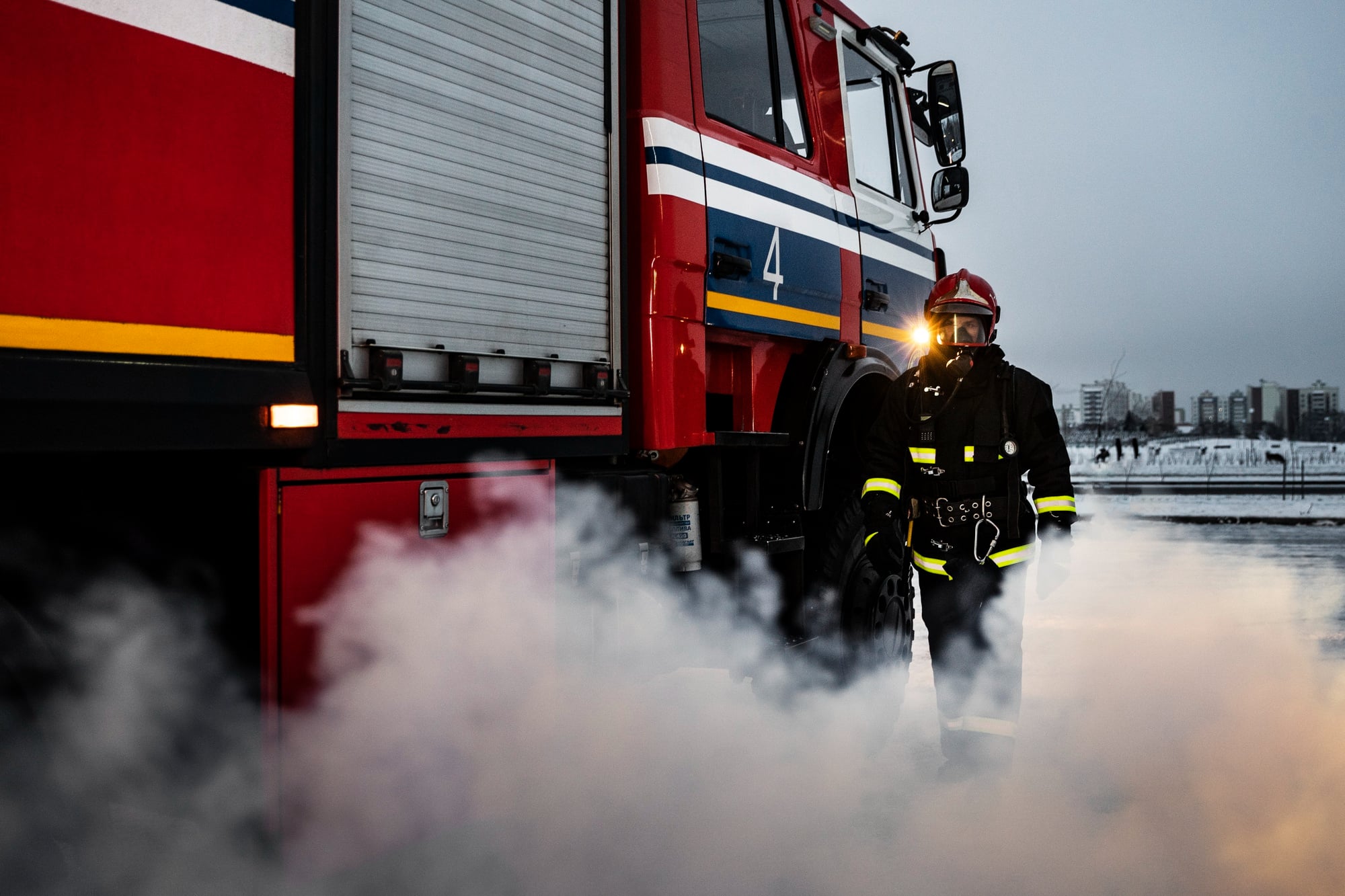
My Father Spent 42 Years Keeping Fire Trucks Running, but at the Anniversary Dinner, They Told Him He Wasn’t Invited

The Man Who Kept the Engines Running
At six-thirty on a Saturday evening, my phone rang.
It was Dad.
I was standing in my kitchen in a bathrobe, waiting for a pot of water to boil for spaghetti. I

almost didn’t answer. Dad never calls at dinnertime. He thinks it’s rude.
“Dad? Is everything okay?”
“I’m heading home,” he said.
His voice was quiet. Calm. The same voice he used my whole life when something was wrong and he didn’t want me to worry.
“What do you mean, heading home? I thought you were staying for dinner.”
There was a pause. I could hear his truck idling. That old Ford with the loose belt that squeals when you start it. He says he’ll fix it someday. He never fixes his own things.
“Seems there was some confusion,” Dad said, “about who was invited.”
My father, Walter Dombrowski, has never been comfortable with attention.
He’s seventy-six years old. Five foot nine. Big hands. Forearms covered in old burn scars and faded tattoos from the Navy. He wears the same gray work jacket he’s worn for twenty years,
even though I’ve bought him three new ones. They’re all still in their boxes in his closet.
He retired six years ago.
He spent forty-two years before that in a repair garage behind Station Four of the Ridgeway
County Fire Department.
He wasn’t the man running into burning buildings.
He was the man making sure the engines started when somebody turned the key.
I grew up in that garage.
A cinderblock building painted beige, behind the station, with three big roll-up doors and a cracked concrete floor stained black with oil. It smelled like diesel and coffee and the orange
hand soap Dad used to scrub the grease off at the end of the day. It never quite came off. His fingernails were always rimmed with black. Even in church. Even at my wedding.
On Saturdays when Mom worked, he’d bring me to the garage. I’d sit on an overturned bucket
with a coloring book while he worked under the trucks on a creeper. I’d hear him talking to the engines. Under his breath. Like they were animals.
“Come on, girl. Come on. Show me what’s wrong.”
“There it is. There you are. I got you.”
When I was six, I asked him why he talked to the trucks.
He rolled out from under Engine Two on his creeper and looked at me upside down.
“Because somebody’s life depends on this truck, Bethie,” he said. “When the bell rings at three in the morning and those boys jump in and turn the key, it has to start. Every time. No excuses.” He tapped the bumper. “So I want her to know I’m paying attention.”
He worked Thanksgiving mornings.
Every year. Mom would put the turkey in at seven and Dad would kiss her goodbye and drive to the garage because Ladder One had a hydraulic leak, or Engine Three’s alternator was going, or
the new rescue truck was making a noise he didn’t like.
He’d come home at one o’clock smelling like diesel and sit down at the table and carve the turkey with grease still under his fingernails.
He worked Christmas Eve.
He worked my eighth birthday. And my tenth. And his own birthday, more years than not.
“Walt,” Mom would say, standing in the doorway with her arms crossed. “It’s your birthday. It’s a
Sunday. Let somebody else do it.”
“There is nobody else, Joanie,” he’d say. “It’s just me.”
That was true. For most of those forty-two years, he was the only full-time mechanic for the whole
county. Fourteen fire trucks. Six stations. Ambulances. Brush trucks. Tankers. The chief’s SUV. One man.
He kept a battered toolbox beneath his workbench. Red. Craftsman. Dented on every side. With
W.D. scratched into the lid with a screwdriver. He bought it in 1978 with his first paycheck from the county.
And he kept a small notebook in his shirt pocket.
Always. Every day. A little spiral notebook. The kind you buy at the drugstore for a dollar. When one filled up, he’d start another.
Every repair went into that notebook.
Date.
Truck number.
What needed fixing.
And the name of whoever had driven it into the shop.
3/14/91. Engine 4. Fuel pump. Dropped by Lt. Garcia.
11/22/02. Ladder 1. Outrigger hydraulic seal. Dropped by FF Kowalczyk.
12/24/09. Rescue 6. Battery. Dropped by Capt. Halloran. Christmas Eve. Merry Christmas, Ray.
When I was a teenager, I asked him why he wrote down who dropped off the truck.
“So I know who I’m keeping alive,” he said.
Dad always said, “A fire truck that won’t start is just an expensive red building.”
He said it to every new firefighter who came through Station Four. He said it at every Fourth of
July cookout. He said it to me when I got my driver’s license and complained about checking the oil.
“Car that won’t start is just an expensive chair, Bethie.”
I’m not proud of this.
But when I was in high school, I was embarrassed by him.
My best friend Jenny Reyes’s dad was a lawyer. My boyfriend’s dad was a dentist. And my dad
came to parent-teacher conferences in a gray work jacket with grease on his hands.
When people asked what my father did, I said, “He works for the fire department.”
Which was true.
I just let them think he was a firefighter.
He knew. Of course he knew. He came to my senior awards night and a teacher said, “Oh, you must be the firefighter!” And Dad looked at me. And I looked at the floor.

He said, “No, ma’am. I’m the mechanic.”
He didn’t say anything to me about it on the drive home. He just turned on the radio. Patsy Cline.
I’ve thought about that drive home a lot. Thirty years. I’ve never apologized for it.
My mother, Joan, died seven years ago. Breast cancer. They were married forty-four years.
A year after she died, Dad retired. He said the garage was too quiet without her calling at noon to ask if he’d eaten lunch.
He lives alone now in the little brick house on Sycamore Street where I grew up. He fixes the neighbors’ lawnmowers for free. He goes to the VFW on Thursdays. He watches the Pirates lose.
He still carries a notebook in his shirt pocket.
He just doesn’t have anything to write in it anymore.
The fire department was celebrating its seventy-fifth anniversary that Saturday.
Seventy-five years. Ridgeway County Fire Department was founded in 1950, after a hotel fire downtown killed eleven people because the volunteer company’s only truck wouldn’t start. That’s the story. Dad told it to me a hundred times.
There was going to be a big dinner. At Station Four. In the apparatus bay. With the trucks pulled out and tables set up where they usually parked. A caterer. A band. The county commissioners. Retired firefighters from all over.
Dad got an invitation in the mail three weeks earlier.
Cream-colored. Heavy paper. With the department seal embossed in gold.
The Ridgeway County Fire Department requests the honor of your presence at its 75th
Anniversary Celebration.
And at the bottom, in blue ink, somebody had written a note by hand.
Walt — you HAVE to come. — R.H.
Dad held it up to the light at his kitchen table. He read it four times. He didn’t say anything. But I saw his hands shaking a little.
“Who’s R.H.?” I asked.
“Ray,” Dad said. “The chief.”
He put the invitation on his refrigerator with a magnet shaped like a fire hydrant.
He even bought himself a new pair of shoes.
I couldn’t believe it. My father hasn’t bought new shoes since 2011. He wears his old work boots everywhere. To church. To the doctor. To my daughter’s graduation.
But two weeks before the dinner, he drove to the JCPenney at the mall and bought a pair of black
dress shoes. Leather. Laces. He showed them to me in the box like they were made of gold.
“Too fancy?” he asked.
“They’re perfect, Dad.”
He polished them three times.
He got a haircut. He ironed his one good shirt. White. He bought a tie. Navy blue with little red fire hydrants on it. He saw it at the JCPenney and laughed out loud right there in the store.
He looked at himself in the mirror in his front hallway on Saturday afternoon. In his white shirt and his fire hydrant tie and his new black shoes.
And his gray work jacket. Over the top of all of it.
“Dad,” I said. “Maybe not the jacket.”
“It’s chilly,” he said.
It was sixty-eight degrees.
He wore the jacket.
I offered to drive him.
“No need, sweetheart,” he said. “I’ve been driving there since before you were born.”
He kissed me on the cheek at five-forty-five. He got in his old Ford. The belt squealed when he started it.
He drove away.
And at six-thirty, my phone rang.
“Dad,” I said. “What do you mean, confusion? Who wasn’t invited?”
He didn’t want to tell me. I could hear it. He kept saying it was nothing. It was fine. He was tired
anyway. He’d just go home and watch the game.
“Dad. Tell me what happened.”
He sighed.
When I finally got the story out of him, I felt sick.
He’d parked in the back lot. Where he always parked. By the fence, behind the garage. His spot. For forty-two years.
He’d walked around to the front of Station Four. The big bay doors were open. Music was coming out. Warm yellow light. People laughing. Men and women in dress uniforms. Navy blue with gold buttons. Their families in suits and dresses.
There was a table at the entrance. With a white tablecloth and a stack of name tags and a young man with a clipboard.
Twenty-two, maybe. Twenty-three. Neat haircut. A black suit that was a little too big for him. A
lanyard around his neck that said EVENT STAFF.
Dad handed him the invitation.
The young man looked at it. He looked at his clipboard. He flipped a page. He flipped another.
“I’m sorry, sir,” he said. “What’s your name?”
“Walter Dombrowski.”
The young man ran his finger down the list. Twice.
“I don’t see you, sir,” he said. “Are you with one of the stations? Retired personnel?”
“I’m retired,” Dad said. “I worked here forty-two years.”
“Which station? What rank?”
“I was the mechanic,” Dad said. “In the garage. Out back. I maintained the trucks.”
The young man looked up from his clipboard.

He looked at Dad’s gray work jacket. At the grease under his fingernails. At the burn scars on the backs of his hands.
“I’m sorry, sir,” he said. Politely. Kindly, even. “This event is for firefighters and their families.
Uniformed personnel. Maintenance people aren’t on the guest list.”
Dad didn’t argue.
He didn’t say, The chief invited me personally. He didn’t say, Look at the note on the invitation. R.H.
He didn’t say, I kept every truck in this county running for forty-two years.
He just nodded.
He held out his hand. The young man looked at it, confused. Then he shook it.
“That’s all right, son,” Dad said. “Hope you folks have a nice evening.”
He handed the invitation back to the young man.
Then he walked outside.
Back around the building. To the back lot. To his old Ford.
He got in.
And he called me.
“Dad,” I said. “Stay there. Do not leave. I’m coming.”
“Bethie, it’s fine. I’m just going to—”
“Wait right there,” I said. “Please. Promise me.”
He was quiet for a moment.
“Okay,” he said. “I’ll wait.”
I turned off the stove. I left the pot of water sitting there. I threw on jeans and a sweater. I didn’t
even brush my hair.
I drove.
It’s eleven miles from my house to Station Four. I did it in fourteen minutes.
By the time I reached the firehouse, his pickup was still parked near the back fence.
Under the light pole. In his spot.
The engine was off. The windows were rolled up.
I pulled in next to him. I got out. I knocked on his window.
He rolled it down.
He was sitting behind the wheel in his white shirt and his fire hydrant tie and his gray work jacket.
His new black shoes. His reading glasses on the end of his nose.
He was holding an old notebook.
Not one of the little drugstore ones. An older one. Bigger. With a brown cardboard cover,
cracked and soft with age. Held together with a rubber band.
He was looking through it.
“Dad,” I said. “Why are you still here?”
He shrugged.
“You told me to wait.”
“I know. But you could have waited at home.”
He looked down at the notebook. He turned a page. Very carefully. The paper was yellow. Brittle.
“Just remembering a few things,” he said.
I looked through the windshield toward the building.
From the back lot, you could see in through a side door. Somebody had propped it open with a fire extinguisher to let the air in. Music drifted out. A band. Playing something by Frank Sinatra.
People were laughing.
Inside, I could see the walls of the apparatus bay. Photographs of former chiefs lined them. Black-and-white ones at the beginning. Then color. Seventy-five years of men and a few women in white helmets, staring solemnly at the camera.
Long tables had been set up where the engines usually parked. White tablecloths. Red and gold ribbons down the middle. Little centerpieces made of old brass fire nozzles with flowers in them.
At the front of the room, there was a stage. Just a little platform. A podium with a microphone. A
big banner behind it.
RIDGEWAY COUNTY FIRE DEPARTMENT — 75 YEARS — 1950–2025
And right in front of the stage, at the head table, there was one empty chair.
Right next to the podium. The best seat in the room.
Everybody else at the head table was already sitting down. The county commissioners. The mayor. A woman in a pantsuit I thought might be our state representative. Five or six older men in dress
uniforms with a lot of gold on their sleeves.
And one empty chair.
A small white card had been placed on it.
Propped up against the back. Like a place card at a wedding.
Dad couldn’t see the card from where we were parked. He was looking at his notebook. And his eyes aren’t what they used to be.
But I could see it.
I squinted. I leaned forward over the hood of his truck.
Before I could read the name, a woman hurried through the entrance.
She came in through the main bay doors. Fast. Forty-five, maybe. Dark hair pulled back. A navy blue dress. She was carrying a wireless microphone in one hand and a clipboard in the other.
She went to the head table. She looked at the empty chair. She looked around the room.
She appeared to be looking for someone.
She asked something of one of the older men at the head table. He shook his head. She asked somebody at the next table. They shook their heads too.
Then the fire chief stepped onto the stage.
I knew him.
Of course I knew him. Everybody in Ridgeway County knew him.
Chief Ray Halloran. Fifty-two years old. Tall. Gray at the temples. A face that looked like it had been carved out of wood and left out in the weather. He’d been chief for nine years. Before that, he was

a captain at Station Four for fourteen years.
When I was a kid, he was just Ray. A young firefighter who used to come to our house for Thanksgiving sometimes. Mom always set an extra place for him. I never knew why.
He stepped up to the podium in his dress uniform. White gloves. Gold buttons. Five gold bugles on his collar.
He tapped the microphone.
The music stopped. The room got quiet.
“Good evening, everybody,” he said. “And welcome to the seventy-fifth anniversary of the Ridgeway County Fire Department.”
Applause. Big applause. Some whistling from the back.
He waited for it to die down.
“Before we begin dinner,” he said, “there’s one person we absolutely cannot start without.”
He smiled. He turned toward the head table.
He looked toward the empty chair.
His smile disappeared.
He looked at the chair for a long moment.
Then he looked around the room. At the tables. At the doors.
He leaned over and whispered something to the woman in the navy dress. The one with the microphone.
She shook her head.
He whispered something else.
She shook her head again. Harder. She looked worried.
The chief lowered the microphone.
The whole room was watching him now. Three hundred people. Nobody said anything. A baby somewhere in the back started fussing. Somebody shushed it.
Then the chief raised the microphone again.
He looked toward the entrance. Toward the table by the big bay doors. Where the young man in the too-big suit was sitting with his clipboard.
And he asked a question that made the entire room go silent.
“Did anybody,” Chief Halloran said slowly, “see an old man in a gray work jacket come through that door tonight?”
From where I was standing by Dad’s truck, I could hear it. The microphone carried. The side door was open.
Dad heard it too.
He looked up from his notebook.
Nobody in the room said anything.
Then a hand went up.
At the entrance table. The young man with the clipboard.
His hand was shaking.
“Sir,” he said. He didn’t have a microphone. But the room was so quiet his voice carried all the way
to the back lot. “There was a man. About twenty minutes ago. In a gray jacket. He said he was a mechanic. He wasn’t on the list.”
The chief stared at him.
“What did you tell him?” he asked.
The young man swallowed.
“I told him the dinner was for uniformed personnel,” he said. “I told him maintenance people weren’t on the guest list.”
I’ve never heard a room that quiet.
Three hundred people. Not one sound. Not a fork. Not a chair. Not a breath.
Chief Halloran set the microphone down on the podium.
He walked off the stage.
He walked down the center aisle between the long tables with the red and gold ribbons. Past the county commissioners. Past the mayor. Past seventy-five years of photographs on the walls.
He stopped at the entrance table.
He looked down at the young man.
“What’s your name, son?”
“Tyler, sir. Tyler Mason. I’m with the county events office. They hired me to do the check-in.”
The chief nodded slowly.
“Tyler,” he said. “Do you know who you just turned away?”
“No, sir.”
Chief Halloran picked up the clipboard. He looked at it. He flipped a page. He flipped another.
“His name’s not on here,” he said quietly.
“No, sir. I checked twice.”
“That’s because his name’s on the chair,” the chief said. “Not the list. I didn’t think anybody would need a list for him.”
He set the clipboard down.
“Where did he go?”
“He said he hoped we’d have a nice evening,” Tyler said. “And he walked out the side. Toward the back lot.”
Chief Halloran turned around.
He looked at the room. At three hundred people in dress uniforms and suits and dresses, sitting at long tables in the apparatus bay of Station Four.
“Everybody,” he said. He didn’t use the microphone. He didn’t need it. “Get up.”
People looked at each other.
“Every firefighter in this room,” the chief said, “every paramedic, every officer, every retiree. Get up.
Right now. We’re going to the back lot.”
They came.
I was standing next to Dad’s truck when they came around the corner of the garage.
First the chief. In his dress uniform with the white gloves and the gold buttons. Walking fast.
Then the woman in the navy dress.
Then the older men from the head table. The ones with gold on their sleeves. Retired chiefs. One of them used a cane.
Then everybody.

Dozens of them. Then more. Firefighters in dress blues. Young ones and old ones. Men and women. Paramedics. Lieutenants. Captains. Retirees with gray hair and canes and oxygen tanks. Some of them with their wives and husbands and kids trailing behind.
They came around the corner of the beige cinderblock garage where my father spent forty-two years. Under the floodlights. Across the cracked asphalt of the back lot.
Like a river.
Dad saw them coming.
He was still sitting behind the wheel with his old notebook in his lap. He looked up through the windshield.
He saw the chief. He saw the crowd behind him.
His face went white.
“Oh, no,” he said. “Oh, no. Bethie. What’s happening?”
“I think,” I said, “they’re coming for you, Dad.”
He reached for the key in the ignition.
I put my hand over his.
“Don’t you dare,” I said.
Chief Halloran reached the truck.
He stopped at the driver’s side window. Dad’s window was still rolled down.
The crowd stopped behind him. A semicircle around the old Ford. Under the floodlights. Hundreds of people. Silent.
The chief bent down so he was eye level with Dad.
“Walt,” he said.
Dad looked at him.
“Ray,” he said. “I’m sorry. I didn’t mean to cause a fuss. The young man was just doing his job. I’ll
just head home. You go on back in and have your—”
“Walt,” the chief said again. “You’re not getting out of this one.”
Dad looked past him. At the crowd. At three hundred faces in the floodlight.
“Ray,” he said quietly. “I’m not a firefighter. I never was. That dinner’s for you all. The ones who go in. I just fixed the trucks.”
Chief Halloran was quiet for a long moment.
Then he reached in through the open window.
He put his white-gloved hand on top of the old notebook in Dad’s lap.
“Can I see it?” he asked.
Dad hesitated.
Then he lifted his hands off it.
The chief took the notebook. Very carefully. Like it was something fragile.
He slid the rubber band off.
He opened the brown cardboard cover.
He didn’t have to look for the page. It was the first one. The very first page.
He read it.
Then he turned around and held it up so I could see it. So everybody could see it. Under the floodlights.
It was dated in faded blue ink. In my father’s handwriting. Younger. Rounder. Shakier.
July 8, 1984.
Engine 4. Main pump. Bearing worn. Cavitating at high pressure. Needs rebuild. Requested parts
from county 3 times. 4/12, 5/30, 6/21. Denied. Budget.
Dropped by Capt. J. Halloran.
He said, “Do what you can, Walt.”
I did what I could. It wasn’t enough.
And underneath, in different ink. Darker. Pressed so hard into the paper it had torn through in two
places.
July 9, 1984.
Henderson Warehouse fire. 2nd alarm.
Engine 4 pump failed at 0214.
Capt. Jim Halloran. KIA.
Age 34. Wife Linda. Son Ray, age 11.
Never again.
I put my hand over my mouth.
The crowd behind the chief had gone completely still. The ones close enough to read it. And the
ones who couldn’t see but knew. Who’d heard the story. Who’d been there, some of them.
Chief Halloran lowered the notebook.
He looked at my father.
“My dad,” he said. His voice was rough. “Captain Jim Halloran. Engine Four. Henderson Warehouse. July ninth, 1984.”
Dad closed his eyes.
“I was eleven,” the chief said.
He told it.
Right there in the back lot of Station Four. With three hundred people listening.
The Henderson Warehouse was a paint and solvent storage building on the east side of town. It caught fire at one-forty in the morning on July ninth. Second alarm. Engine Four was first on scene.
Captain Jim Halloran led the interior attack. Three firefighters went in with him. They were pulling a
line to the back of the building where the fire was spreading toward the solvent tanks.
At 2:14, the pump on Engine Four failed.
The water stopped.
The line went limp in their hands.
Two of the firefighters made it out. One was carried out by the other. Captain Halloran was the last one. He was holding the nozzle. Covering the retreat. Giving his men time to get out.
He didn’t make it.
“The investigation said it was the pump,” the chief said. “The bearing. Worn out. Should’ve been rebuilt months before.”
He looked at Dad.
“And then I found out, a long time later,” he said. “When I made captain. I found the maintenance requests in the county archives. Three of them. April. May. June. All requesting parts for the Engine
Four pump. All signed by the same mechanic.”
He held up the notebook.
“All denied,” he said. “Budget.”
Dad was crying.
Sitting behind the wheel of his old Ford in his white shirt and his fire hydrant tie. Quietly. Tears running down his face into the gray stubble on his chin.
“I should’ve pulled it,” Dad whispered. “I should’ve taken it out of service. I should’ve parked it in the garage and told the county I wasn’t letting it out until they gave me the parts. I should’ve made a fuss.”
“Walt—”
“He brought it in on the eighth,” Dad said. “Your dad. In the afternoon. He said, ‘It’s making that noise again, Walt.’ And I told him, ‘Jimmy, I’ve asked three times. They won’t give me the bearing.’
And he said, ‘Do what you can.’” Dad’s voice broke. “So I packed it with grease and tightened everything I could tighten. And I told him it’d hold. I told him it’d probably hold.”
He put his face in his big scarred hands.
“I told your father it’d probably hold,” he said. “And it didn’t.”
The back lot was completely silent.
Three hundred people. Under the floodlights. Nobody moved.
Chief Halloran reached into the truck.
He put his white-gloved hand on my father’s shoulder.
“Walt,” he said quietly. “Look at me.”
Dad lowered his hands.
“You were twenty-eight years old,” the chief said. “You’d been working here six years. You asked the county for that bearing three times. In writing. They said no. You did everything a mechanic

could do with the parts you had.”
“It wasn’t enough.”
“It wasn’t your fault,” the chief said.
“I’ve been telling myself that for forty-one years,” Dad said. “It doesn’t work.”
Chief Halloran turned the page of the notebook.
He held it up again.
The next entry. The day after the fire. July tenth.
July 10, 1984.
Went to county commissioners meeting. Told them a man died because they wouldn’t buy a $340
bearing. Told them if they ever deny me parts again I’ll go to the newspaper.
They approved full pump rebuild on all 6 engines. And new budget line for maintenance. Effective immediately.
Started this book today.
Every truck. Every repair. Every name.
So I always know who I’m keeping alive.
The chief turned another page. Then another. Then he flipped through them fast. Page after page after page. All of them full. Dates. Truck numbers. Repairs. Names.
Dropped by FF Garcia.
Dropped by Lt. Kowalczyk.
Dropped by Capt. Novak.
Dropped by FF Halloran.
The chief stopped on that one.
Sept. 3, 1995. Engine 4. Full brake job. Dropped by FF R. Halloran. His first week on the job. Same truck his dad rode. Told him she’d never let him down.
“I remember that day,” the chief said quietly.
He was looking at the page.
“My first week,” he said. “Assigned to Station Four. Engine Four. The same engine. They rebuilt it
after ‘84. Same chassis. New everything else.” He swallowed. “I was scared to death to get in it. I brought it back to the garage for a brake job and I stood there in the doorway and I couldn’t move.”
He looked at Dad.
“And you rolled out from under it on your creeper,” the chief said. “And you looked at me upside down. And you said, ‘Ray, I’ve rebuilt every part of this truck with my own hands. Twice. She will
never, ever let you down. That’s a promise.’”
Dad was crying harder now.
“And she never did,” the chief said. “Not once. Thirty years.”
Then the chief turned around. He held the notebook up high. Over his head. So the whole crowd could see it.
“Forty-two years,” he said. Loud. His voice carried across the whole back lot. “Forty-two years this
man ran the garage. Fourteen trucks. Six stations. Most of that time, by himself.”
He looked at the crowd.
“I had the archivist pull the records last month,” he said. “Every work order. Every repair. Since
1978.”
He paused.
“Sixty-one thousand, four hundred and twelve repairs,” he said.
Somebody in the crowd gasped.
“And after July ninth, 1984,” Chief Halloran said, “do you know how many times a Ridgeway County fire truck failed to start on a call? Or lost pressure at a scene? Or broke down en route?”
He looked at my father.
“Zero,” he said. “Not one. Not one time. In thirty-six years.”
Somebody in the back started clapping.
Then somebody else. Then the whole crowd. Three hundred people. In the back lot of Station Four. Under the floodlights. Applauding.
Dad sat behind the wheel of his old Ford and shook his head. He kept shaking his head. Like he
couldn’t make it stop.
“No,” he kept saying. “No. I just fixed the trucks.”
One of the old men from the head table stepped forward. The one with the cane.
He was eighty, maybe. Stooped. White hair. A dress uniform with a lot of gold on the sleeves.
He walked up to the truck. Slowly. Leaning on his cane.
“Walt,” he said.
Dad looked at him. His face changed.
“Mike,” he said. “Mike Garcia.”
“Lieutenant Mike Garcia,” the old man said. “Retired. Engine Four. July ninth, 1984.”
Dad stopped breathing.
“I was on the line with Jimmy,” Mike Garcia said. “When the pump went. I was right behind him. I
was the one who got carried out.”
He reached in through the window. He put his old, shaking hand on top of my father’s.
“I’ve been alive forty-one years because of what you did the day after,” he said. “Because you went to the commissioners and made them fix every pump in the county. I went on four hundred more fires after that. Four hundred, Walt. Every single truck started. Every single pump held.”
He squeezed Dad’s hand.
“I married my wife in 1986,” he said. “We had three kids. Seven grandkids. Two great-grandkids.” His voice broke. “None of them would be here if you hadn’t made a fuss.”
Then a woman stepped forward. Fifty-ish. Short gray hair. In a dress uniform with captain’s bars.
“Walt,” she said. “Captain Diane Novak. Station Two.”
Dad looked at her.
“November 1998,” she said. “Ladder One. The aerial got stuck at the Riverside Apartments fire. I
was at the top. On the tip. Pulling a kid out of a fourth-floor window.”
Dad’s face changed.
“The hydraulics,” he whispered.
“The hydraulics,” Captain Novak said. “Everybody thought I was going to have to climb down. With the kid. Four stories. In the smoke.” She swallowed. “And then it started moving again. Smooth. Like nothing happened.”
“I’d replaced the main valve the week before,” Dad said quietly. “It was on the list. It wasn’t due for six months. I just had a feeling.”
“You had a feeling,” Captain Novak said. “And the kid’s name was Marcus Bell. He was six. He’s
thirty-three now.” She turned around. She pointed into the crowd.
A tall man in a dress uniform. Firefighter. Young face. Tears running down it.
“He joined the department in 2015,” Captain Novak said. “Station Four.”

They kept coming.
One after another. Under the floodlights. Walking up to my father’s truck.
A paramedic whose ambulance made it to the hospital in 2007 with a baby who wasn’t breathing
because Dad had replaced the transmission three days before.
A firefighter whose brush truck didn’t stall in the middle of the Pike Ridge wildfire in 2012 because Dad had stayed at the garage until two in the morning the night before, rebuilding a fuel pump.
A retired captain whose rescue truck got to a car wreck on Route 30 in eleven minutes in a blizzard in 2003 with chains Dad had custom-fitted.
They each said their names. They each said what happened.
And every single time, Dad remembered.
“Engine Three. Alternator. March.”
“Rescue Six. Battery. Christmas Eve. You dropped it off, Ray.”
“Tanker Two. Brake line. I remember. You told me your wife was pregnant.”
He remembered all of them.
Every truck. Every repair. Every name.
Then Tyler Mason came forward.
The young man with the clipboard. In his too-big black suit. With his EVENT STAFF lanyard.
He walked up to the truck very slowly. His face was red. His eyes were wet.
He stopped at the window.
“Sir,” he said. “Mr. Dombrowski. I’m so sorry.”
Dad looked at him.
“I didn’t know,” Tyler said. “I’m from the county events office. They hired me three weeks ago. They gave me a list. I didn’t know who you were. I thought… I looked at your jacket and I thought…” He stopped. “I’m so sorry. I judged you by your clothes. I’m so sorry.”
Dad looked at him for a long time.
Then he reached out the window and held out his hand.
The same way he did at the entrance table.
Tyler looked at it. Then he shook it.
“Son,” Dad said. “You were doing your job. They gave you a list. You followed it.”
“I should have asked—”
“Maybe,” Dad said. “But here’s something I learned in forty-two years in that garage.” He nodded at the beige cinderblock building behind them. “The people with grease on their hands are usually the ones holding the whole thing together. Nobody sees them. Nobody puts them on the list. But
if they stop showing up, everything stops running.”
Tyler nodded. He was crying.
“Remember that,” Dad said. “Next time somebody shows up at your table in a work jacket.”
“Yes, sir,” Tyler whispered. “I will.”
Chief Halloran opened the truck door.
“Come on, Walt,” he said. “Your chair’s getting cold.”
Dad got out of the truck.
Slowly. His knees are bad. Forty-two years on a concrete floor and a creeper will do that.
He stood up in the back lot under the floodlights. In his white shirt. His fire hydrant tie. His new
black shoes. And his gray work jacket.
He looked down at himself.
“Ray,” he said. “I’m not dressed right. Look at me. Everybody’s in uniform. I can’t walk in there in
this jacket.”
Chief Halloran looked at the jacket.
Then he did something I’ll never forget.
He unbuttoned his own dress uniform jacket. The navy blue one. With the gold buttons and the five gold bugles on the collar. The chief’s jacket.
He took it off.
And he handed it to my father.
“Wear this,” he said.
Dad stared at it.
“Ray, I can’t. That’s the chief’s jacket.”
“I know,” the chief said. “I’m the chief. I can do whatever I want with it.”
He held it out.
Dad didn’t move.
“You wore my father’s name in your notebook for forty-one years,” Chief Halloran said quietly.
“You can wear my jacket for one night.”
Dad took off his gray work jacket.
He handed it to me. I held it against my chest. It smelled like diesel and coffee and orange hand
soap.
Chief Halloran helped him into the navy blue dress jacket. It was too big in the shoulders. Too long in the sleeves. The chief buttoned it for him. All the gold buttons. One by one.
He stepped back.
And the whole back lot started clapping again.
They walked him in.

Chief Halloran on one side. Lieutenant Mike Garcia with his cane on the other.
Three hundred people walked behind them. Around the corner of the garage. Through the big bay doors. Into the apparatus bay of Station Four.
Under the photographs of seventy-five years of chiefs.
Down the center aisle between the long tables with the red and gold ribbons.
To the head table.
To the empty chair.
I was walking right behind them. Holding Dad’s gray work jacket.
And when we got to the head table, I finally saw the card.
The small white card propped up on the empty chair.
Typed in gold letters.
WALTER J. DOMBROWSKI
Guest of Honor
42 Years. 14 Trucks. 61,412 Repairs.
Every Engine. Every Call. Every Time.
Dad looked at the card.
He stood there for a long time in the chief’s jacket that was too big for him.
Then he sat down.
The chief went back to the podium.
He picked up the microphone. He was in his white shirt now. No jacket. White gloves still on.
“Before we begin dinner,” he said, “there’s one person we absolutely cannot start without.”
He looked at my father.
“And now he’s here,” he said.
The room exploded.
The chief gave a speech.
I won’t remember all of it. I was crying too hard.
But I remember some.
He talked about July ninth, 1984. About his father. About being eleven years old and standing at the window of their house on Chestnut Street waiting for a truck that never brought his dad home.
He talked about Walter Dombrowski coming to their house the week after the funeral. Standing on
the porch with his hat in his hands. Telling Ray’s mother everything. The bearing. The three requests. The denials. I told him it’d probably hold, ma’am. I’m sorry. I’m so sorry.
“My mother let him in,” the chief said. “She sat him down at the kitchen table. She poured him a cup
of coffee. And she said, ‘Walt, Jimmy told me about you. He said you were the only one in the county who ever fought for those trucks.’”
The chief looked at my father.
“She said, ‘Don’t you ever stop fighting.’”
He talked about Walt coming to the house every year after that. On July ninth. Every single year. With a box of doughnuts.
“He never missed one,” the chief said. “Thirty-nine years. Until my mom passed in 2023. He’d sit at our kitchen table and drink coffee with her and they wouldn’t say much. Just sit there.”
I didn’t know this.
I’d never known this.
July ninth. Every year. Dad would leave the house early. Mom would say, He’s got something to do. I never asked what.
“And when I was fourteen,” the chief said, “I was getting into trouble. Fights at school. Skipping class. Angry at everything. And Walt came to the house one Saturday and said, ‘Ray, I need some help at the garage. You busy?’”
The chief smiled.
“I wasn’t busy,” he said. “So I went. And he put me on a creeper and handed me a wrench and slid me under Engine Two. And he said, ‘Your dad used to say a fire truck that won’t start is just an
expensive red building. Let’s make sure this one starts.’”
He looked at the room.
“That was my dad’s line,” he said. “Not Walt’s. My dad said it first. Walt’s been saying it for forty-
one years so nobody would forget.”
I looked at my father.
He was sitting at the head table in the chief’s jacket with his hands folded in front of him. Staring at
the tablecloth.
His shoulders were shaking.
“Every Saturday for four years,” the chief said. “He taught me engines. Transmissions. Hydraulics.
Pumps. Especially pumps. He made me take apart a pump and put it back together forty times.”
He laughed.
“I joined the department because of him,” he said. “I became a firefighter because a mechanic who
blamed himself for my father’s death spent four years teaching me how to make sure it never happened again.”
He looked at Dad.
“And then I became chief,” he said. “And I signed every maintenance budget for nine years. And I never once denied a single part Walt asked for.”
Then he held up something.
A plaque. Brass. On dark wood.
He read it.
THE WALTER J. DOMBROWSKI APPARATUS MAINTENANCE FACILITY
Dedicated on the 75th Anniversary of the Ridgeway County Fire Department, in honor of the man who kept the engines running.
“A fire truck that won’t start is just an expensive red building.”

— Capt. James Halloran, 1950–1984
— Walter Dombrowski, 1984–2019
“The garage,” the chief said. “Out back. Where you spent forty-two years. As of tonight, it has
your name on it.”
Dad put his hand over his mouth.
“And one more thing,” the chief said.
He nodded at somebody at the back of the room.
The big bay doors at the front of Station Four rolled up.
Outside, on the apron, under the floodlights, there was a fire truck.
Brand new. Gleaming red. Chrome bumpers. White roof. So new it still had the paper on the step treads.
Engine Four.
The new Engine Four. The department bought it that spring. It was going into service the next week.
And painted on the driver’s side door, in gold leaf, under the department seal, in old-fashioned
script:
In Memory of Capt. James Halloran
And underneath that:
Maintained by W. Dombrowski
Dad stood up.
He didn’t say anything. He walked out from behind the head table. Down the center aisle. Past
three hundred people. In the chief’s jacket that was too big for him.
He walked out the big bay doors.
He walked up to the new Engine Four.
He put his hand flat on the door. On the gold letters. On his name. Under Jim Halloran’s.
He stood there for a long time.
Then he turned around.
He looked back at the chief, who’d followed him out.
“Ray,” he said. His voice was shaking. “Can I?”
The chief reached into his pocket.
He pulled out a key.
He handed it to my father.
Dad climbed up into the cab.
Slowly. His knees. The chief gave him a hand.
He sat down in the driver’s seat. He looked at the dashboard. At all the switches and gauges and lights. He put his hands on the steering wheel.
He was quiet for a long moment.
He put the key in the ignition.
And he talked to it.
Under his breath. I couldn’t hear the words. But I knew what he was saying. I’d heard it a thousand times on a thousand Saturdays, sitting on an overturned bucket with a coloring book.
Come on, girl. Show me what you’ve got.
He turned the key.
It started.
Of course it started.
A deep, rumbling roar. The whole apron shook with it. The lights came on. Red and white. Flashing
across the front of Station Four.
Three hundred people standing in the bay doors started cheering.
And my father sat behind the wheel of the new Engine Four with his eyes closed and his hands on
the steering wheel.
Listening to it.
Like he was making sure.
Later, much later, after dinner, after the band played and the chief made everybody line up to shake Dad’s hand, after Lieutenant Mike Garcia told the story about Jim Halloran three more times and cried every time, I drove my father home.
He left his truck in the back lot. In his spot. Behind the garage that had his name on it now.
He sat in my passenger seat in the chief’s jacket. He wouldn’t take it off. The chief told him to keep it until Monday.
He held his old notebook in his lap. The one with the brown cardboard cover. Held together with a rubber band.
We didn’t say anything for a while.
Then I said it.
“Dad. I’m sorry.”
He looked over at me.
“For what?”
“Senior awards night,” I said. “1995. The teacher said, Oh, you must be the firefighter. And you looked at me. And I looked at the floor.”
He didn’t say anything.
“I let people think you were a firefighter,” I said. “My whole time in high school. I was embarrassed. I was embarrassed that you were the mechanic.”
My voice broke.
“I’m so sorry, Dad,” I said. “I didn’t know. I didn’t know anything.”
He was quiet for a long time.
The streetlights went by. Sycamore Street. Almost home.
“You know what your mother said,” Dad said finally. “After awards night? In the kitchen?”
“What?”
“She said, ‘Walt, she’ll figure it out someday.’” He almost smiled. “I said, ‘Figure what out?’ And your mother said, ‘That the man who keeps the engine running matters as much as the man who drives it.’”
He looked down at the notebook.
“She said you’d figure it out,” he said. “She just didn’t know it’d take thirty years.”
I laughed. Through the tears.

“I’m slow,” I said.
“You get that from me,” Dad said.
We pulled into the driveway of the little brick house on Sycamore Street.
Dad didn’t get out right away.
He opened the notebook. The old one. He turned past the first page. Past July eighth and July ninth and July tenth, 1984.
He turned all the way to the back.
To the last page that had writing on it.
It was dated six years ago. His last day.
Dec. 20, 2019. Engine 4. Final inspection before retirement. Everything perfect. Dropped by Chief R. Halloran.
Told him she’d never let him down.
Last entry.
Below it, the rest of the page was empty.
Dad took a pen out of his shirt pocket. Under the chief’s jacket.
He clicked it.
And he wrote.
Oct. 18, 2025. New Engine 4. Started on the first try.
Dropped by Chief R. Halloran.
Named for Jimmy.
I think he’d have liked it.
Then he paused.
He wrote one more line.
Bethie drove me home.
That was a year ago.
Dad goes to the garage every Saturday morning now.
The Walter J. Dombrowski Apparatus Maintenance Facility. With a brass plaque on the door.
He doesn’t work there. He’s retired. He’s seventy-seven.
But on Saturdays, he teaches.
The county has two full-time mechanics now. And an apprenticeship program. Chief Halloran set it
up last winter. Four young people a year. They learn diesel engines and hydraulics and pumps.
Especially pumps.
Dad makes every one of them take a pump apart and put it back together forty times.
One of the apprentices is Tyler Mason.
He quit the county events office in January. He showed up at the garage on a Saturday morning in jeans and an old sweatshirt and asked Dad if he could learn.
Dad looked at him for a long time.
“You know what you’re getting into?” he said. “Grease. Cold mornings. Christmas Eve. Nobody’s ever going to put your name on a list.”
“I know, sir,” Tyler said. “That’s why I want to do it.”
Dad slid a creeper across the floor with his foot.
“Get under Tanker Two,” he said. “Tell me what’s wrong with it.”
Tyler carries a notebook now.
In his shirt pocket. A little spiral one. From the drugstore. A dollar.
Every repair goes in it.
Date.
Truck number.
What needed fixing.
And the name of whoever dropped it off.
I saw it once. Dad showed me. He was proud.
On the first page, in Tyler’s handwriting, it said:
Jan. 11, 2026. First day. Tanker 2. Leaking brake line. Mr. D showed me.
Started this book today.
Every truck. Every repair. Every name.
So I always know who I’m keeping alive.
Every July ninth, Dad still drives to the house on Chestnut Street.
Ray’s mother is gone now. So Ray lives there. He moved in after she passed.
Dad brings a box of doughnuts. They sit at the kitchen table and drink coffee. They don’t say much.
This year, I went with him.
I sat at the table and listened to two men who’d known each other for forty-two years not say much.
At one point, Ray got up and went to a drawer. He came back with an old photograph. Black and
white. Creased.
A young man in a firefighter’s turnout coat, standing next to a fire truck. Grinning. A cigarette behind his ear.
And next to him, a younger man. Skinny. In a gray work jacket. With grease on his hands and a wrench in his back pocket. Grinning too.
Engine 4 — 1983 — Jimmy & Walt
Somebody had written it on the back in pencil.
Ray slid it across the table to me.
“Your dad was something,” he said. “Before you were born. He was the best mechanic in the state.
Everybody wanted him. Pittsburgh offered him twice as much. Philadelphia offered him three times as much.”
I looked at my father.
“You never told me that.”
Dad shrugged.
“Why didn’t you go?” I asked.
He was quiet for a moment.
He looked at the photograph. At the young man with the cigarette behind his ear.
“Because I made a promise,” he said. “To Jimmy. And to his boy.”
He nodded at Ray.
“And because somebody had to make sure the engines started,” he said.
People ask me sometimes what my father did for a living.
I used to say he worked for the fire department.
Now I tell them the truth.
He was the mechanic.

He was the man nobody saw. The man in the gray work jacket who wasn’t on the list. The one who worked Thanksgiving mornings and Christmas Eve and his own birthday. The one who slid under fourteen trucks on a creeper for forty-two years so that when the bell rang at three in the morning
and somebody turned the key, it would start.
Every time.
He wasn’t the one running into burning buildings.
He was the reason the people running into burning buildings got to run back out.
He keeps the chief’s jacket in his closet now. Ray told him to keep it. Forever.
It hangs next to his gray work jacket.
The navy blue one with the gold buttons. And the gray one that smells like diesel and coffee and orange hand soap.
Side by side.
I asked him once which one he likes better.
He thought about it for a long time.
“The gray one,” he said finally.
“Why?”
He smiled.
“Because nobody ever had to put my name on a list to wear it,” he said.