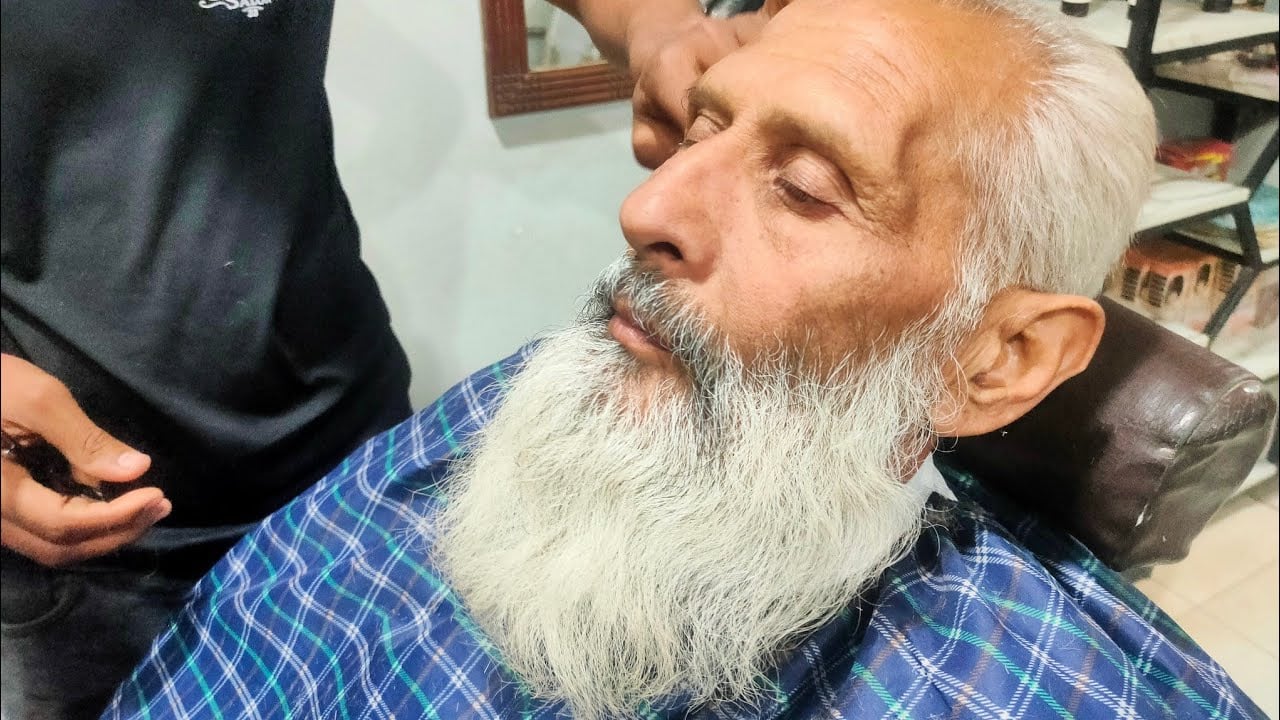
I Gave a Homeless Man a Free Haircut Before His Job Interview, Then He Showed Me the Same Tattoo My Mother Had

It was 6:52 on a Thursday night when the old man walked into the salon.
Eight minutes until closing.
I was sweeping hair from under my station, already thinking about the leftover lasagna in my fridge and the electric bill sitting unopened on my kitchen counter. I had no idea those eight

minutes were about to change my whole life.
He came in quietly. He held the door behind him so it wouldn’t slam, the way you do when you’re used to being told you’re too loud just by existing.
His clothes were worn and dirty. A brown corduroy jacket gone shiny at the elbows. Gray pants with dark stains around the cuffs. Old work boots, and the left one was split open at the toe so I could see a gray sock poking through.
His gray hair hung unevenly past his ears. His beard looked like he had tried to trim it himself with a pair of kitchen scissors and no mirror.
But it was his eyes that stopped me.
Pale blue. Gentle. Deep smile lines folded at the corners like he used to laugh a lot, a long time ago.
For one strange second, he reminded me of my grandfather. Pop had eyes like that. Pop had
helped my mother raise me in a little rented house in Pasadena, Texas, and he used to take me for snow cones every Saturday in the summer.
The old man walked to the reception desk.
Kayla, our receptionist, didn’t even look up from her phone.
“Can I help you?”
“Yes, ma’am.”
He reached into his jacket pocket and pulled out a crumpled dollar bill.
“I have a job interview tomorrow morning,” he said. “I was hoping I could get a haircut.”
He set the dollar on the counter and smoothed it flat with both hands, slowly, carefully, like it was
something valuable.
“I can pay this today. And maybe I could bring the rest next week. I get paid on Fridays if they hire me.”
Kayla finally looked up. She stared at the dollar. Then at him.
“A haircut is fifty dollars.”
Her eyes moved down his jacket, his pants, his broken boot.
“You need to leave.”
The man lowered his eyes.
“I could sweep,” he said. “Clean the bathrooms. Take out the trash. Anything you need.”
His voice got softer.
“Nobody has offered me an interview in months, miss. I just want to look like someone they might hire.”
That was when our manager, Brenda, came out of the back office. Brenda was fifty-four, wore her reading glasses on top of her head, and spent most of her day fighting with the landlord about the lease on our building. The rent had gone up $1,100 a month in July, and she had been in a bad
mood ever since.
She took one look at the man and folded her arms.
“You’re holding up paying customers.”
The salon was completely empty. Every chair. Every dryer. Every sink.
But the man didn’t argue.
“Yes, ma’am. I’m sorry for bothering you.”
He picked up his dollar and folded it in half. Then in half again. And again, until it was a tiny square no bigger than a postage stamp. He tucked it back into his pocket.
Then he turned toward the door.
And as he reached for the handle, the sleeve of his jacket slid up his arm.
That’s when I saw the tattoo on his left wrist.
A bluebird.
Small. Faded to a soft gray-blue. Its wings spread wide, like it was just about to take off.
My heart stopped.
My mother had the exact same tattoo.
Same wrist. Same size. Same bird, same wings, same tilt of the little head.
When I was little, I used to sit in her lap and trace that bird with my finger while she watched TV.
“What does the bird mean, Mama?”
And she always gave me the same answer.
“That’s a story for when you’re older, baby.”
I asked when I was eight. She said the same thing.
I asked when I was fifteen, after I got grounded for sneaking out, and I said it just to make her mad. She said the same thing.
I asked when I was twenty-three, sitting next to her hospital bed in the oncology unit at Memorial
Hermann, holding her hand while the morphine drip clicked. She smiled at me and said, “Later, Lucy-girl. Later.”
There was no later.
She died eleven days after that.
Apparently, I never got old enough.
The man pulled the door open. The little bell jingled. Cold air came in from the parking lot.
“Wait,” I said.
It came out louder than I meant it to.
Everyone looked at me. Kayla. Brenda. The man in the doorway.
“My chair is free,” I said.
Brenda frowned. “Lucy.”
“I’ll cut his hair.”
“He can’t pay.”
“I know.”
Brenda pulled her glasses down onto her nose and looked at me over them.
“Then the fifty dollars comes out of your paycheck. I’m not eating it. Not with what that landlord is charging me.”
I thought about my bank account. $612 in checking until payday. Rent was $1,050, due on the first.

My mother’s old hospital still sent me a statement every few months for the balance her insurance hadn’t covered, and I still paid them forty dollars a month, even six years later, because I couldn’t stand the idea of her name sitting in a collections file somewhere.
Fifty dollars mattered.
“Fine,” I said.
Brenda stared at me for a long moment. Then she shook her head and walked back into her
office. She didn’t close the door all the way.
The old man stood frozen in the doorway like he wasn’t sure he was allowed to come back in.
“Please,” I said. “Come sit.”
He walked toward my chair slowly, the way you walk toward a dog you’re not sure is friendly.
“I’ll get it dirty,” he said, looking at the black leather seat.
“It wipes clean.”
“You really don’t have to do this, miss.”
“I know I don’t. Please sit.”
He lowered himself onto the very edge of the chair, like he was ready to jump up the second someone changed their mind.
I snapped a black cape around his shoulders. Up close, he smelled like cold air and cheap soap.
Not dirty. Just tired.
“You can call me Lucy,” I said.
He looked at me in the mirror.
And something changed in his face. Something moved behind those pale blue eyes, like a door opening and closing very quickly.
“Lucy,” he repeated quietly. Like he was tasting the word.
“What’s your name?”
He hesitated. Just a second too long.
“Ray.”
I started with a wide-tooth comb.
His hair was tangled and matted in the back, the kind of knots that only happen when you sleep on cots and don’t have a mirror. It took me almost ten minutes just to work through it. I went
slowly. I didn’t want to hurt him.
He never complained. Not once.
But I noticed something.
Ray kept watching me in the mirror.
Not in a creepy way. Not like the men who sometimes sat in my chair and asked if I had a boyfriend. It was different. He looked at me the way people look at an old photograph they
found in the back of a drawer. Like he was trying to memorize me.
And every few minutes, his eyes filled with tears. He’d blink them back and look down at his hands under the cape.
I figured he was emotional because someone was finally being nice to him. I’d seen it before. People who’ve been turned away enough times sometimes cry when you just say hello.
But I couldn’t stop thinking about that bluebird.
I wanted to ask. The question kept climbing up my throat.
Where did you get that tattoo?
I didn’t ask. I don’t know why. Maybe I was afraid the answer would be something ordinary. A
tattoo parlor in Houston. A design off a wall. A coincidence.
Maybe I was afraid it wouldn’t be.
So I kept cutting.
The silence got heavy, so I did what I always do with quiet clients. I talked.
“My mother used to cut my hair at our kitchen table,” I said.
Ray went completely still under the cape.
“She was terrible at it,” I laughed. “My bangs were always crooked. Every school picture from first grade to sixth, crooked bangs. You can see them in the yearbooks.”
He didn’t say anything.
“That’s probably why I became a stylist, honestly. Self-defense.”
Nothing. His hands were gripping something under the cape.
“She used an old bedsheet as a cape. A yellow one with little daisies on it. She’d tie it around my
neck with a clothespin.”
Still nothing.
“And she always sang the same song while she did it. Every single time.”
In the mirror, I saw Ray’s chin start to tremble.
I kept going, because I didn’t know what else to do.
“It was something about bluebirds. Flying over a rainbow.”
His eyes lifted slowly to meet mine in the mirror.
And tears rolled straight down his cheeks into his ragged beard.
“Over the Rainbow,” he whispered.
My scissors stopped in midair.
That was the song. Exactly that song. My mother sang it off-key every time, and she always got the words wrong in the second part, and she never cared.
“How do you know that?” I asked.
He didn’t answer.
I stood there holding my scissors for what felt like a full minute. Then, because my hands needed something to do, I finished the last section of hair above his left ear. Snip. Snip. I set the scissors down on the counter.
And that’s when Ray broke.
He didn’t cry quietly. His whole body shook under the black cape. His shoulders heaved. He put his face in his hands, and the sound that came out of him was something I had only heard once
before, at my mother’s funeral, from Pop.
Kayla looked up from her phone with her mouth open.
“Ray?” I said. I put my hand on his shoulder. “Ray, are you okay? Are you hurt?”
He shook his head. He took a long, ragged breath. Then he turned around in the chair and looked at me. Not in the mirror. At me.
“Your mother asked me never to contact you,” he said.
The room tilted. I grabbed the edge of the counter.
“What?”
“But I don’t have much time left.” His voice cracked right down the middle. “And I couldn’t leave
this world without seeing you once. Just once.”
I could barely breathe.
“Do we… do we know each other?”
Ray reached inside his corduroy jacket. His fingers were shaking so badly it took him two tries. He pulled out an old envelope, yellowed at the edges, soft from being handled a thousand times. The corners were rounded like river stones.
“I’ve been looking for you for years,” he said.
He held it out to me.
On the front, written in faded blue ink, were five words.
For Lucy. When he’s earned it.
I knew that handwriting instantly. The loopy L. The way the y curled under itself like a little tail. I had seen it on every lunch-bag note, every birthday card, every grocery list stuck to our fridge with a
Galveston magnet.
My mother’s handwriting.
“Where did you get this?” My voice didn’t sound like mine.
“She gave it to me.”
“When?”
“Two months before she died.”
I took a step backward. My hip hit the rolling cart, and a bottle of hairspray fell over.
“No,” I said. “No. That’s not possible. She was in the hospital. She was sick.”
Ray lowered his head.
“She drove out to see me at the state correctional facility in Huntsville,” he said quietly. “She came on a Tuesday. She’d lost a lot of weight. She was wearing a scarf on her head.”
I stared at him.
I remembered that scarf. Blue with white flowers. I bought it for her at Target when her hair started falling out.
And I remembered a Tuesday, two months before she died, when she told me she was going to
a “doctor’s appointment in Conroe” and wouldn’t let me drive her. She came home exhausted and went straight to bed and wouldn’t talk.
“She told me she was dying,” Ray said. His voice was shaking. “She told me all about you. That
you were funny. That you had a big laugh. That you became a hairdresser.”
He looked down at his hands. Rough hands. Long fingers. Wide knuckles.
“She said you had my hands.”
I looked down at my own hands.
Long fingers. Wide knuckles. My mother always said I got my hands from “somebody else in the family.” She never said who.
My heart started pounding so hard I could feel it in my ears.
“She gave me this envelope,” Ray said, “and she told me I could find you only if I stayed clean.”
He swallowed.
“I’ve been clean nine years.”
Then he lifted his eyes and looked straight at me.
“I think you deserve to know who I am.”
That’s when Brenda came out of her office.
She must have heard the crying. She walked up fast, keys in her hand, her face already tight with irritation. Then she saw Ray, red-eyed and shaking in my chair. And she saw me, white as a sheet,
holding an old envelope.
“Is he bothering you, Lucy?”
“No.”
“Then what is happening out here?”
I looked at Ray.
At the bluebird on his wrist.
At my mother’s handwriting.
And I said something I never in my life imagined I would say.
“I think he might be my father.”
Brenda stopped dead.
Kayla put her phone face-down on the desk.
Nobody said anything for a long time. The only sound was the little fountain by the front window
that Brenda bought because some magazine said it brought good luck to small businesses.
Then Brenda did something I didn’t expect.
She walked to the front door, turned the lock, and flipped the sign from OPEN to CLOSED.
She came back and pulled out the chair from the station next to mine. She set it down facing Ray.
“Sit down, Lucy,” she said. “Take all the time you need. Kayla, go make some coffee.”
Kayla went. Without a word.
I sat down. My knees were shaking. I held the envelope in my lap, but I didn’t open it.
“Tell me everything,” I said to Ray. “From the beginning.”
So he did.

He met my mother, June, when they were both nineteen.
She worked at a snow-cone stand on the seawall in Galveston. It was a little white shack with a striped awning and a hand-painted sign. He worked as a deckhand on a shrimp boat out of Pier
19, and he walked past that stand every afternoon after the boat came in.
“I saw her the first day and couldn’t say a word,” he said. A tiny smile pulled at his mouth. “So I bought a cherry snow cone. Then the next day, I bought another one. For three weeks straight, I
bought a cherry snow cone every single afternoon. I spent half my paycheck on those things. I hate cherry.”
I laughed. I couldn’t help it. It came out wet and choked.
“Finally, one day, she leaned out the window and said, ‘Are you going to keep buying snow cones, or are you going to ask my name?’”
That sounded exactly like her. Exactly. My mother never waited for anybody to work up their
nerve.
“What did you say?”
“I said, ‘What’s your name?’ And she said, ‘June. And yours is Cherry, apparently.’” He wiped his
eyes. “She called me Cherry for a year.”
They were together for four years. They lived in a one-bedroom apartment over a bait shop. They had a radio and a mattress on the floor and a hot plate.
“On her twentieth birthday,” Ray said, “we got matching tattoos. Little place on Broadway. Forty dollars each. She picked the design.”
He held up his left wrist. The faded bluebird.
“Why bluebirds?” I asked.
Ray smiled faintly.
“Because of the song. She sang it constantly. In the shower. Doing dishes. Driving. She said
bluebirds were for people who would make it over the rainbow someday. People who’d get somewhere better.”
His smile slowly disappeared.
“I was the one who didn’t make it.”
When Ray was twenty-two, he hurt his back hauling nets on the boat. Two herniated discs. The captain had no workers’ comp coverage, so Ray got nothing except a handshake and a final
check for $340.
The emergency room doctor gave him a prescription for pain pills.
“They worked,” he said simply. “That was the problem. They worked on everything. My back. The
bills. Being scared. Everything.”
Then the prescription ran out.
His need for them didn’t.
He started buying them off a guy at the docks. Then the pills got too expensive and he found something cheaper. He started lying. He started missing work. He started taking money out of the coffee can where my mother kept her tips.
“She counted that can every Friday,” he said. “She was saving for a deposit on a real apartment. One with a bedroom door. She had $700 in there once. Then she had $300. Then she had nothing.”
He couldn’t look at me while he said it.
Then my mother found out she was pregnant.
“She sat me down at the little table by the window,” Ray said, “and she said, ‘Get clean or get out. I’m not raising a baby with a man who steals from a coffee can.’”
He tried. He told me he tried over and over again. He went to meetings in a church basement. He got clean for three weeks. Then two months. Then nine days.
Then he’d relapse.
I was born in April at a county hospital in Galveston.
“I was there,” Ray said, and his voice went soft. “I held you. You were so small. You had a little pointy head, and you were mad about everything.”
He laughed weakly.
“I promised you I’d change. I said it out loud, right to your little face. ‘I’m gonna be better for you.’”
Four months later, Ray walked into a convenience store on 61st Street with a pocketknife and demanded the money in the register.
He got $286.
The police picked him up two hours later, sitting in his truck in a Walmart parking lot. He was too high to drive.
“Aggravated robbery,” he said. “The clerk was a nineteen-year-old kid named Marcus. I scared him
half to death. That’s the part I think about most. Not the prison. That kid’s face.”
He was sentenced to fifteen years.
My mother visited him once, with me in a car seat, in the visitation room at the county jail before
he was transferred. He said she didn’t cry. She just sat across the table and told him what was going to happen.
“She said, ‘I’m taking Lucy to my daddy’s house in Pasadena. I’m going to raise her myself. Don’t
write. Don’t call. When you’re out, don’t come looking.’”
He was quiet for a long moment.
“She was right,” Ray said. “If I had stayed in your life back then, I would have broken your heart

over and over and over. Every birthday I didn’t show up for. Every promise. She saw that. She protected you.”
I didn’t say anything. I couldn’t.
Kayla came back and set a cup of coffee in front of each of us. Nobody touched them.
Ray told me the rest slowly.
Prison didn’t fix him. Not at first. He got paroled early once and relapsed within four months. He
got violated and sent back.
“That was my rock bottom,” he said. “Not the robbery. Going back. Sitting in that intake room at forty-one years old, realizing I had wasted my entire life, and nobody in the world even knew
where I was.”
So he signed up for a serious recovery program inside the prison. Twelve months, intensive, with a counselor named Mr. Delgado who didn’t let him get away with anything.
“He’d say, ‘Ray, the only person you’re lying to is the guy in the mirror, and that guy already knows.’”
Ray got clean. Then he stayed clean.
He got a job in the prison laundry. Twenty-five cents an hour. Then he moved up to the print shop at forty cents an hour.
“Do you know what I did with that money?” he asked me.
I shook my head.
“The judge ordered me to pay restitution to the store. Two hundred eighty-six dollars, plus the damage, plus the clerk’s counseling costs. Three thousand four hundred twelve dollars total.” He
smiled a little. “At forty cents an hour, that takes a long time. But I paid every cent. Took me almost six years. I still have the letter from the court clerk saying the balance was zero.”
Then, one day, three years into staying clean, a guard told him he had a visitor.
“Nobody visited me,” he said. “Ever. Not in all those years. I thought it was a mistake.”
It wasn’t a mistake.
It was my mother.
Wearing the blue scarf I bought her.
“She sat down across from me and said, ‘Hello, Cherry.’” His voice broke completely. “Twenty-three years, Lucy. And the first thing she said was ‘Hello, Cherry.’”
I put my hand over my mouth.
“She told me she was dying. Stage four. She said the doctors gave her a few months. She said she’d been thinking about it a long time and she didn’t want to leave this world with secrets.”
Then she slid the envelope across the visiting table.
“She said, ‘Lucy deserves to know where she came from. But only if you stay clean. Not for me. Not for her. For yourself.’”
Ray looked at the envelope in my lap.
“She told me to wait five years after I got out. Five full years clean on the outside. She said, ‘Anybody can stay clean behind a fence, Ray.’”
I stared at him.
“And you did? You waited five years?”
“I waited.”
He raised his tattooed wrist.
“I got out almost six years ago. I lived in a halfway house in Houston for a year. Then I worked at a car wash. Then a warehouse until they laid everybody off in the spring. Then I lost my room and
ended up at the Star of Hope shelter on Reed Road.”
He touched the bluebird with one finger.
“Some nights, that envelope was the only thing keeping me from giving up. I’d take it out and just
hold it. I never opened it. It wasn’t mine to open.”
His voice cracked.
“I wanted to earn it.”
My hands were shaking when I finally slid my finger under the flap.
It wasn’t sealed anymore. The glue had dried up years ago. But it had never been opened. I could tell by the way the paper was still folded.
Inside was a photograph.
An old Polaroid, a little faded at the edges.
My mother. So young I almost didn’t recognize her. Maybe twenty-three. Sitting up in a hospital
bed in a thin cotton gown, holding a newborn baby wrapped in a striped blanket.
Me.
Standing beside the bed was a young man with shaggy brown hair and pale blue eyes. He was
leaning down to kiss the top of my head. His eyes were closed.
Both of them were wearing hospital bracelets.
And on both of their left wrists, right above the plastic bands, were two little bluebirds.
I turned the photo over. In my mother’s handwriting, on the back:
Lucy June. April 9th. 7 lbs 2 oz. All three of us.
All three of us.
Then I unfolded the letter. Two pages, front and back, in her handwriting. It got shakier toward the end. I could tell she was already weak when she wrote it.
She told me the truth.
All of it. The snow cones. The apartment over the bait shop. The pills. The coffee can. The robbery.
She explained why she had hidden Ray from me my whole life. She wrote that she had been angry. Furious, for years. And scared. Scared that if I knew about him, I would spend my whole
childhood waiting by the window for a father who might never come.
“I couldn’t let you be that little girl,” she wrote. “I was that little girl once, waiting for my own mother. I know what it does to you.”
But she also wrote about walking into that prison visiting room.
She wrote that when she saw him sober, clear-eyed, taking responsibility for every single thing he had done without one excuse, she saw a piece of the boy who bought cherry snow cones he
didn’t even like.
She didn’t tell me to forgive him.
She didn’t tell me to accept him, or love him, or let him into my life.

She just gave me a choice. The choice she said she should have given me years ago.
And near the very end, in handwriting that was almost falling off the line, she wrote:
You were wanted, Lucy. By both of us. Never forget that. You were wanted.
That sentence broke me.
I folded over in that salon chair and cried like I hadn’t cried since her funeral. Huge, ugly, gulping sobs. Kayla came out from the back with a box of tissues and set it on the counter and quietly
walked away again.
Ray didn’t touch me. He didn’t try to hug me or pat my back or say anything. He just sat there. Waiting. Letting me feel it.
I remember thinking, even in the middle of it, that he was being careful. That he knew he hadn’t earned the right to hold me.
When I finally looked up, my face soaked, he silently pulled a tissue from the box and held it out.
I took it. I blew my nose loudly.
Then I looked at the letter again, at one line near the middle, and I asked the first normal question that came into my head.
“So. Mom says here you cut my hair when I was four months old.”
Ray’s eyes went wide.
“She told you that?”
“She says it was terrible.”
And for the first time that whole night, Ray laughed. A real laugh. It burst out of him.
“She was not lying. You had this little patch of fuzz sticking straight up, and I thought I’d just trim
it. I took the kitchen scissors and I cut one side way too short. You looked like a tiny little monk.”
And somehow, I started laughing too.
We sat there in the closed salon, at almost eight o’clock at night, crying and laughing about a
haircut that happened twenty-nine years ago.
Before Ray stood up to leave, Brenda came back over.
She had been standing near her office door the whole time. I saw her wipe her eyes once and
pretend she was fixing her glasses.
“Lucy,” she said. “I’m not taking the fifty dollars out of your check.”
“Brenda, you don’t—”
“I’m not doing it. End of discussion.”
Then she turned to Ray. She looked uncomfortable. Brenda was not a woman who apologized easily. I had worked for her for four years, and I’d heard her apologize exactly once, to a bride
whose hair dye came out orange.
“And I owe you an apology,” she said.
Ray listened quietly.
“You came in here asking for help,” Brenda said. “You offered to clean my bathrooms. And I treated you like you were dirt on my floor.” She shook her head. “That’s not who I want to be. I’ve been so busy worrying about my lease and my rent that I forgot what this place is supposed to
be for.”
Then she looked down at his broken boot. At the gray sock poking through the split.
“What size do you wear?”
Ray blinked. “Eleven.”
“My husband wears eleven. He’s got a pair of work boots in the garage he bought last year and wore twice because he said they pinched. I’ll bring them in tomorrow.”
Ray opened his mouth to say no.
“Don’t argue with me,” Brenda said. “I’m a terrible person to argue with. Ask Lucy.”
“She’s a terrible person to argue with,” I said.
Ray smiled.
“Thank you, ma’am.”
I asked him what time his interview was. Nine-thirty, he said, at the Eastwood Community Center on
Lockwood. A maintenance job. Twenty-two hours a week to start, $14.50 an hour.
“How are you getting there?”
“Bus. The 30 runs past the shelter.”
“I’ll drive you,” I said. “I’m off tomorrow. I’ll pick you up at eight.”
He looked at me for a long time.
“You don’t have to do that.”
“I know I don’t,” I said. “I want to.”
The next morning, I pulled into the parking lot of the Star of Hope shelter at 7:55 a.m. Ray was already standing outside by the front gate, his hands in his jacket pockets. He’d probably been
there since seven.
Brenda had come in early before her first client and dropped off a paper grocery bag at my apartment. Inside were her husband’s work boots, barely scuffed. A blue button-down shirt still in
the store packaging, with the receipt for $24.99 taped to it. A brown leather belt. And a folded twenty-dollar bill with a sticky note that said: Lunch. Don’t argue. —B.
Ray changed in the shelter bathroom.
When he walked back out, I almost didn’t recognize him.
Clean hair, cut short and neat. His beard trimmed close. The blue shirt tucked in. The belt. The good boots.
He stood up straighter. He walked differently.
He looked like someone people might finally give a chance.
I drove him to the community center and waited in the parking lot with the engine running and the
heater on. I couldn’t sit still. I checked my phone a hundred times. I reread my mother’s letter twice.
Forty minutes later, the glass doors opened.
Ray walked out next to a heavyset man with a gray mustache and a lanyard around his neck. They were talking. The man had his hand on Ray’s shoulder.
They walked right up to my car. I rolled down the window.

“Are you his daughter?” the man asked.
I hesitated.
It was a simple question. Yes or no. But it felt like stepping off the edge of something.
“Yes,” I said.
It was the first time I had ever said it out loud.
The man smiled and reached in to shake my hand. “Frank Torres. I’m the director here.”
“Lucy.”
“Lucy, your father sat in my office and told me everything.” He shook his head slowly. “The prison. The drugs. The robbery. The shelter. Every bit of it, without me asking. No excuses. No blaming his
childhood or the system or anybody. Just the facts.”
He looked at Ray.
“I’ve done a lot of hiring in twenty years. You know how many people tell me the truth that plainly?
Almost none.” He clapped Ray on the shoulder. “You start Monday, Ray. Seven a.m. Bring your Social Security card and an ID for the paperwork. We’ll get your direct deposit set up.”
Ray nodded. He didn’t say anything. I don’t think he could.
When Frank walked away, Ray climbed into my passenger seat and sat there staring at the dashboard for a long time.
“I have a Social Security card,” he finally said. “I don’t have a bank account. I haven’t had a bank
account in thirty years.”
“Then we’ll go open one,” I said. “Right now.”
We drove to my credit union on Fairmont Parkway. A young woman named Destiny at the new
accounts desk helped him fill out the paperwork. He had his state ID from the halfway house and his Social Security card in a plastic sleeve he kept inside the envelope with my mother’s letter.
He deposited Brenda’s twenty dollars.
Destiny printed a little receipt. Savings account. Opening balance: $20.00.
Ray held that receipt like it was a diploma.
“I’m gonna build this up,” he said. “You watch.”
That afternoon, we went to a diner on Spencer Highway and ate cheeseburgers and drank chocolate milkshakes, and I paid with my card while he wasn’t looking.
For the first time, I asked him normal questions. The kind you’re supposed to know about your
father without asking.
What was his favorite movie? The Shawshank Redemption, he said, and then laughed at himself for a full minute.
Favorite food? Gumbo. His grandmother’s, from Lake Charles.
What was my mother like at nineteen?
He thought about that one for a long time.
“Loud,” he said. “Bossy. Brave. The bravest person I ever met. She’d pick a fight with a hurricane if it looked at her wrong.”
That was her. That was exactly her.
And he asked me about my life. Beauty school. My first salon job. The apartment. The ex-boyfriend who borrowed $2,300 for a car repair and then broke up with me by text. Pop’s funeral, four years ago.
He listened to every word like he was being paid to memorize it.
I want to be honest about what came next, because people like to hear that everything was beautiful after that.
It wasn’t. Not all the time.
Some days, I loved having him around. I loved getting a text from him at 6 a.m. that said Good morning Lucy, have a good day at work with a little bird emoji he had figured out how to use. I
loved showing him my favorite taco truck. I loved that he laughed exactly like I do, with his whole head tipped back.
Other days, I was furious.
I’d be driving home and suddenly think about my fifth-grade father-daughter dance, where Pop took me because “your daddy can’t make it.” I’d think about my high school graduation, Mom and Pop in the bleachers holding a poster board sign. I’d think about every night my mother sat
at the kitchen table with a calculator and a stack of bills, trying to make $1,900 a month stretch for three people. Every overdraft notice. Every time the electric company sent a pink shutoff warning.
And I’d think about him, sitting in a cell, while she did all of it alone.
One Sunday, about two months in, we were sitting at a picnic table at Burnett Bayland Park, and I finally asked him.
“Why did you choose drugs over us?”
He didn’t flinch. He didn’t defend himself. He didn’t say “it’s complicated” or “you don’t understand addiction.”
He just said, “There’s no answer that makes it okay.”
“I don’t need it to be okay,” I said. “I need it to be true.”
Ray stared down at his hands on the wooden table for a long time.
“At first,” he said slowly, “every time was a choice. Every single time. I knew what I was doing. I
knew I was stealing from her. I chose it anyway, because I wanted to feel good more than I wanted to be good.”
Then his voice got very quiet.
“But after a while, it stopped feeling like choosing. It felt like falling through a floor that wasn’t there anymore. Like I’d step where the floor used to be and just keep dropping.”
He looked up at me.
“That doesn’t excuse anything. I put myself on that floor. Nobody pushed me.”
Then he started listing things. Slowly. Like he had memorized them.
“Your first steps. Your first word. Your first day of school. Your first lost tooth. The first time
some boy broke your heart. Your graduation. Your mama getting sick. Your mama’s funeral. Your granddaddy’s funeral.”
His eyes filled up.
“I missed every bit of it. All of it. That’s on me, Lucy. Nobody else. Not the pills. Me.”
I didn’t say anything.
“You’re allowed to be angry at me for the rest of my life,” he said. “I mean that. You don’t ever

have to stop.”
He paused.
“I’ll still show up every Sunday. Angry or not. You don’t even have to talk to me. I’ll just show up.”
I looked at him for a long moment. Then I reached across the picnic table and took his hand. The
left one. The one with the faded bluebird.
“Then show up,” I said.
And he did.
Every single Sunday. Rain or shine. Even when he got tired. Even when he started getting much more tired than a man his age should be.
The night he told me he didn’t have much time left, I had thought he was being dramatic. Maybe he was just old and sad.
He wasn’t.
In February, he collapsed in the boiler room at the community center. Frank Torres called me from the ambulance.
At Ben Taub Hospital, a cardiologist named Dr. Asha Menon sat down with both of us in a small
room with a box of tissues on the table. She explained it carefully. Years of substance use had badly damaged Ray’s heart. Cardiomyopathy. The heart muscle was weak and enlarged. It couldn’t pump the way it should.
“With medication and good follow-up care,” she said, “we might be looking at a year. Maybe two. I want to be honest with you both.”
Ray nodded like he’d already known. He probably had.
I didn’t nod. I sat there and stared at the tissue box.
Then the bills started coming.
Ray’s job didn’t offer health insurance until he’d worked there six months and gone full-time. He’d
been there five months and nineteen days.
The first statement from the hospital was $38,700 for three nights, the ambulance, and a heart catheterization.
Ray sat at my kitchen table and read it and went gray.
“I can’t pay this,” he said. “Lucy, I’ll be paying this from the grave.”
“You’re not paying it,” I said. “We’re going to fix it.”
I’d learned something from all those years watching my mother fight with her own medical bills. You don’t just pay what they send you. You ask questions.
I took a personal day from the salon. We went to the hospital’s financial assistance office with his
pay stubs, his bank statement from the credit union, and a letter from the shelter confirming where he’d been living. A financial counselor named Mrs. Patterson helped us apply for the hospital’s charity care program and for Medicaid.
It took six weeks and three phone calls where I was on hold for over an hour.
But in April, a letter came. Ray’s income qualified him. The hospital wrote off the entire balance under its financial assistance policy. Medicaid approved his coverage going forward for his
medications and his follow-up appointments.
Balance due: $0.00.
Ray read that letter four times.
“Your mother used to do that,” he said. “Fight with people on the phone until they gave up. I’d forgotten that.”
I helped him get his treatment started. Pills in a weekly organizer. Appointments written on my
calendar in red. A low-salt grocery list taped inside his cabinet in the little studio apartment he’d moved into in March, $725 a month, with a window that looked out at a pecan tree.
But I didn’t pretend the past had disappeared.
We didn’t play family like it was a TV movie. We didn’t suddenly act like he’d been there all along.
We simply started building whatever we could, in whatever time we had left.
One Thursday afternoon in May, about seven months after he first walked into the salon, the little
bell over the door jingled.
I looked up from a client’s foils.
It was Ray.
He was wearing his community center uniform. A navy blue work shirt with a white patch sewn over the left pocket, and in red stitching on the patch, his name. RAY.
He walked straight past me to the front counter. Kayla looked up from her phone.
“Is Ms. Brenda here?”
Brenda came out of the back office. She stopped when she saw him.
Ray reached into his back pocket and pulled out his wallet. A real wallet, black leather, that I’d
bought him for his birthday in March. He opened it and counted out two twenties and a ten, very carefully, and laid them flat on the counter.
“I owe this salon for a haircut,” he said.
Brenda shook her head. “Ray. You don’t owe us anything.”
“Yes, ma’am. I do.”
He pushed the money a little closer to her.
“I said I would pay. I stood right here and said I’d bring the rest next week.” He smiled. “It’s been a long week. But I want to be somebody who does what he says. I spent thirty years being somebody who didn’t.”
Brenda looked at the money. Then at him. Then at me. Her eyes were wet again. She was crying a lot more since Ray came along, and she blamed it on menopause.
Finally, she picked up the bills. She opened the register drawer, put them in, and printed out a
receipt. She tore it off and handed it to him.
“Paid in full,” she said.
Ray tucked the receipt into his wallet like it was a hundred-dollar bill.
Then he turned around and looked at me across the salon. My client watched in the mirror.
“Hi, Lucy,” he said.
I put down my foil brush. I looked at my father standing in the middle of my salon in his work
shirt with his name sewn on it.
“Hi, Dad.”
It was the first time I ever called him that.

His face crumpled. It just folded in on itself. And at the very same moment, somehow, it lit up from the inside, brighter than I had ever seen it.
My client, Mrs. Hutchins, who was seventy-eight and had been coming to me for three years,
reached for a tissue from my station and said, “Well, now I’m crying in my foils. Thanks a lot, honey.”
That moment stayed with me. It’s still with me. Some nights I close my eyes and I can see exactly
how his face looked.
We got fourteen months together.
Fourteen months from the night he walked into my salon with a dollar bill and a split boot.
They became some of the most meaningful months of my entire life.
In June, on a hot Saturday, we drove down to Galveston. Fifty minutes down I-45 with the windows open because my air conditioning was broken and I couldn’t afford the $680 repair yet.
We walked along the seawall. Ray walked slowly now. He had to stop and rest on the benches every few hundred feet, and I pretended I just wanted to look at the water.
He tried to find the old snow-cone stand. He walked right to where he said it had been, near 25th
Street.
It was gone. A surf shop stood in its place.
Ray stood there for a long time looking at the surf shop.
“Right there,” he said. “Window was right there. She’d lean out with her elbows on the counter.”
But a few blocks down, we found another snow-cone stand. A little blue trailer with a line of kids in front of it.
Ray bought me a cherry.
“Cherry?” I said. “I thought you hated cherry.”
“You’re not me,” he said. “You’re her. She loved cherry. She just never told me, because she wanted
me to keep coming back.”
Then he turned to the girl at the window and ordered a blue raspberry.
“For your mother,” he said.
We sat on a bench facing the gulf. He took one big bite and then turned and stuck out his tongue at me. It was bright, ridiculous, electric blue.
I laughed so hard I dropped my snow cone right onto the sidewalk.
He bought me another one without saying a word.
That summer, on my thirtieth birthday, I went to a tattoo shop in the Heights. I brought the old Polaroid from the hospital and showed the artist.
“That one,” I said. “Exactly like that. Left wrist.”
A bluebird. Same size. Same design. Same tilt of the little head, wings spread like it was about to take off.
The next Sunday, I showed Ray.
He didn’t say anything at first. He just reached over and laid his left wrist next to mine on the table. His faded gray bird. My fresh, bright blue one.
Two bluebirds, side by side.
“Two out of three,” he whispered.
In the fall, Ray asked me to go somewhere with him on a Tuesday. He wouldn’t tell me where. He
just said, “Wear something nice.”
It was a legal aid office downtown, on the third floor of an old brick building. A woman in a gray cardigan named Margaret Ellison met us in the waiting room. She was a volunteer attorney who
helped low-income people with wills, she said.
I sat in a plastic chair while Ray signed his name on a simple, three-page will. Margaret’s assistant notarized it with a heavy stamp. Two other volunteers signed as witnesses.
“Dad,” I said in the hallway afterward. “What is this?”
“It’s not much,” he said. “I don’t want you to be surprised, that’s all. I don’t want you fighting with any hospital or any bank trying to figure out what’s yours.”
“You don’t have to leave me anything.”
“I know I don’t.” He smiled. “I want to.”
He’d also signed up for the life insurance through the community center when he went full-time in
May. A small group policy. He’d listed me as the beneficiary.
“Your mama raised you on tips and snow-cone money,” he said. “I want you to have something from me that I earned clean. That’s all. It’s the only inheritance I’ve got. I wish it was more.”
Then he made me promise not to bring it up again. And I didn’t.
Ray died the following July.
A week before, he was back at Ben Taub, in a room on the fourth floor. He could barely get out
of the bed by then. His ankles were swollen. He slept a lot.
One afternoon, he woke up and looked at me sitting in the vinyl chair by the window.
“Lucy,” he said. “Will you do me one last favor?”
“Anything.”
“Will you cut my hair?”
The next morning, I brought my good scissors. My black cape. My comb. A spray bottle.
The nurses helped me prop him up against the pillows. I snapped the cape around his shoulders, the same way I did that first night.
And I carefully trimmed his hair while he sat there with his eyes half-closed.
About halfway through, without really deciding to, I started singing.
The song my mother sang at the kitchen table. The song about bluebirds and rainbows. I sang it off-key, the way she did. I got the words wrong in the second part, the way she did.

Ray closed his eyes.
Then, very quietly, in a voice like dry paper, he started singing along with me.
A nurse stopped in the doorway with a blood pressure cuff in her hand. She stood there and
listened and didn’t come in.
When I finished, I held up the little hand mirror from my kit.
Ray studied himself for a long time. He turned his head left. Then right.
“Perfect,” he said.
He smiled at me.
“Not one crooked piece.”
That was our last real conversation. After that, he mostly slept. I held his hand, the one with the bluebird, and talked to him about nothing. The salon. Mrs. Hutchins’s new hip. The pecan tree outside his window.
He died early on a Wednesday morning, with the window open and the sun just coming up.
A few days after the funeral, I went to his little studio apartment to pack up his things.
There wasn’t much. Two pairs of work pants. His uniform shirts with RAY on the pocket. Brenda’s
husband’s boots, worn soft now. A Bible from the prison chaplain. A paperback copy of a Louis L’Amour novel with the cover falling off.
In the top drawer of his nightstand, I found his wallet.
Inside was his state ID. The receipt from the salon that said Paid in full. A picture of me at the snow-cone stand, laughing with blue raspberry on my chin.
And behind all of it, tucked into the little slot where most people keep a spare key, I found
something small and folded.
The dollar bill.
The same dollar he had smoothed out on Kayla’s counter that very first night. Still folded into that
tiny square, no bigger than a postage stamp.
He had kept it the entire time. Fourteen months. He never spent it.
I sat down on his narrow bed and held that little square of paper and cried until the light outside
the window changed.
Two weeks later, Margaret Ellison called me from the legal aid office.
She asked me to come in. She sat me down in the same room where Ray had signed his will and
went over everything with me slowly, page by page.
Ray’s savings account at the credit union. The one he had opened with Brenda’s twenty dollars. He had deposited a little from every paycheck. Fifty dollars here. Thirty there. Never missed a week.
Balance: $6,184.27.
And the group life insurance policy through the community center. The payout was $15,000, she said. It would come directly to me as the named beneficiary. It didn’t need to go through
probate.
“He came in to update the paperwork twice,” Margaret said. “Wanted to make sure your name was spelled right. He said you’d been spelled wrong on enough things in your life.”
I laughed and cried at the same time, which I had gotten very good at.
Margaret slid one more thing across the table. A plain white envelope, sealed this time.
On the front, in shaky blue ballpoint, in handwriting I had only seen on birthday cards and grocery notes for fourteen months:
For Lucy. You earned it.
Inside was a single sheet of lined paper.
Lucy,
Your mama gave me a choice I didn’t deserve. You gave me a chair I didn’t deserve. Do something with this money that gives somebody else a chair. That’s all I want. That’s all I ever wanted.
I’ll be the bluebird. Look for me.
Dad
I framed the dollar bill.
It’s in a simple black frame now, still folded into its tiny square, hanging right beside my mirror at work. Clients ask about it all the time. Sometimes I tell them the whole story. Sometimes I just say, “It’s the best tip I ever got.”
A year and a half later, I’m still at the same salon.
But something changed after Ray. In me. In Brenda. In the whole place.
I took Ray’s savings and the insurance money and I sat down with Brenda in her office with a
calculator, the way my mother used to sit at our kitchen table. We worked out what it would cost. Capes, clippers, shampoo, combs, hand towels, coffee, the electric bill for one extra day a month, and paying Kayla and the two other stylists who volunteered to come in.
Ray’s money covers almost three years of it.
Brenda put in the rest. She also finally signed a new five-year lease with the landlord after months of fighting, and she got him to knock $300 a month off the rent when she told him what we were
doing with the space. I don’t know exactly what she said to him. I’ve learned not to ask Brenda how she wins arguments.
So now, on the first Sunday of every month, we close to regular clients.
Instead, we give free haircuts to anyone who needs them.
People from the shelters. People walking in from the bus stop. People with job interviews the next morning. Veterans. Teenagers aging out of foster care with one duffel bag and nowhere to go. A
grandmother getting ready for her grandson’s wedding who can’t afford a salon anymore on her Social Security check.
Anyone who needs somebody to look at them and see a person worth helping.
We call it Bluebird Sunday.
There’s a sign in the front window. Kayla painted it herself. A blue bird with its wings spread wide
over a little rainbow. And underneath, in white letters:
EVERYBODY DESERVES TO LOOK LIKE SOMEBODY WORTH HIRING.
Frank Torres from the community center sends people to us every month. Mrs. Hutchins brings
donuts. Last spring, Destiny from the credit union started setting up a folding table by the door on Bluebird Sundays, helping people open free savings accounts with a five-dollar starting deposit. Some of them have never had a bank account in their lives.
She hands every single one of them their little printed receipt.
And every single time, I think about Ray holding his like a diploma.
Recently, on a cold, gray Bluebird Sunday in October, the bell over the door jingled.
An older man stood in the doorway.
Gray hair, long and uneven. A thin windbreaker that wasn’t nearly warm enough. Sneakers with the soles coming loose.

He looked around the salon like he wasn’t sure he was in the right place. Like he was waiting for someone to tell him to leave.
I put down my comb and walked over.
“Come on in,” I said. “It’s cold out there.”
He came in slowly. He held the door behind him so it wouldn’t slam.
I led him to my chair. He sat down on the very edge of it.
Then he reached into his pocket and pulled out a single wrinkled dollar bill. He held it up to me in the mirror with a shaky hand.
“It’s all I have,” he said. “I’m sorry. I know it’s not enough.”
I smiled at him.
“Put it away.”
He blinked at me.
I snapped a black cape around his shoulders.
“Today,” I said, “it’s free.”
In the mirror, behind his reflection, I could see the little black frame beside my station. The tiny
folded square of a dollar bill that a man once carried for fourteen months and never spent.
And on my left wrist, holding the comb, the bluebird.
My mother believed bluebirds were for the people who eventually made it over the rainbow.
Somewhere better. Somewhere far away.
For a long time, I thought that meant some perfect ending out there in the distance. Something you had to wait your whole life for.
I don’t think that anymore.
Sometimes the rainbow is just this.
A stranger standing in a doorway at eight minutes to closing.
A chair you decide to offer.
Fifty dollars you weren’t sure you could spare.
Twenty minutes of kindness with a comb and a pair of scissors.
Because sometimes, the stranger who walks through your door really is just a stranger. Somebody tired and cold who needs a little help.
And sometimes, he’s the father you never knew. The one your mother kept a secret for thirty
years. The one who carried an envelope through nine years of staying clean, just hoping to earn the right to open your door.
You can’t tell which one he is by looking at his shoes.
So sometimes, all you can do is look up from your sweeping and say, “My chair’s free.”
And see who sits down.