Researchers Uncover New Clues About Hidden Structures Beneath Egypt’s Giza Pyramid
“Researchers Uncover New Clues About Hidden Structures Beneath Egypt’s Giza Pyramid”
As new discoveries by scientists point to buried structures more than 4,000 feet below the surface, the search for a fabled underground metropolis beneath Egypt’s pyramids has intensified.
According to a team of Italian researchers, they have discovered a limestone platform with gigantic chambers that include descending channels that resemble pipelines, as well as massive vertical shafts enclosed in spiral staircases.

If verified, these findings have the potential to change how the Giza pyramid complex is historically understood.
The researchers announced at a press conference that they had discovered a water system more than 2,100 feet below the Khafre Pyramid, beneath the limestone platform.
The idea that there might be a whole secret world beneath the surface of the earth is fueled by the appearance of underground passageways that go further deeper.
Similar to how sonar maps ocean depths, the team’s sophisticated radar technology employed pulses to produce high-resolution photos of the earth beneath the pyramids in order to make these discoveries. The pictures point to a system of underground buildings that have been hidden for decades.
The results have drawn skepticism despite the ground-breaking promises. The claims have been rejected by numerous experts as being overblown or lacking scientific support.
The idea of a huge underground city is unrealistic since existing technology cannot reach such depths in the earth, according to Professor Lawrence Conyers, a radar specialist from the University of Denver.

He did concede, though, that there might be little tunnels and chambers that predate the construction of the pyramids.
Conyers pointed out that important natural formations like tunnels and caves, which were revered by ancient societies like the Mayans, were frequently the site of pyramid construction.
This raises the idea that the pyramids of Egypt might be situated above secret underground areas that have ceremonial and historical importance.
Before publishing a film describing their research, the study’s team—which included Egyptologist Armando Mei, Filippo Biondi from the University of Strathclyde in Scotland, and Corrado Malanga from the University of Pisa in Italy—presented their findings in Italy.

A peer-reviewed scientific journal has not yet published the findings, thus independent verification is still pending.
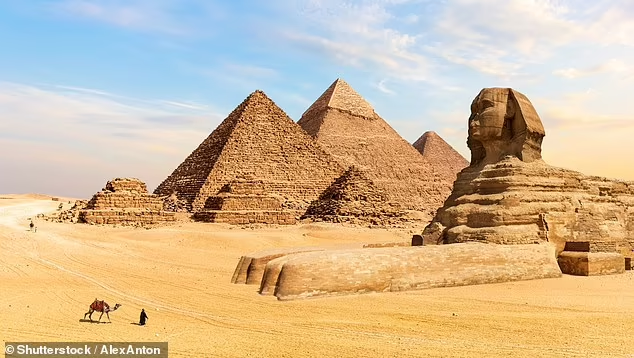
The Khafre Pyramid, which is a component of the Giza complex together with Khufu and Menkaure, was the subject of their inquiry.
Constructed over 4,500 years ago, these pyramids served as imposing graves for pharaohs. According to the study, vertical shafts that are 33 to 39 feet in diameter and located beneath Khafre may have a structural purpose that keeps the pyramid from collapsing.

It was calculated that Khafre’s massive weight needed a firm base. Large shafts were found, which raises the possibility that they are serving as supports and halting subsidence.
The cylindrical constructions might have served as entrances to the subterranean system, the researchers added.
The researchers discovered two massive rectangular enclosures beneath these shafts, each spanning roughly 260 feet on each side. There are further shafts inside these enclosures that go deeper beneath.
The mystery surrounding the location is increased by radar photos taken throughout the study that seem to reveal intricate glowing structures beneath the pyramid.
The fabled Hall of Records, a hypothetical room thought to contain ancient wisdom and the mysteries of Egyptian society, may be connected to these discoveries, according to some scholars.
Although there is currently no tangible proof to back up this theory, historians and archaeologists have long been captivated by the possibility of a secret room.
In a different peer-reviewed investigation that was published in the scientific journal Remote Sensing in 2022, Malanga and Biondi discovered ramps and secret chambers within Khafre.
Similar radar technology is used in their most recent studies, but satellite imaging is an added benefit.
Two satellites orbiting about 420 miles above Earth sent radar signals during their most recent research. The Khafre Pyramid reflected these signals, and the manner they returned aided in creating three-dimensional maps of the subterranean buildings.
Researchers were able to “see” through solid stone by translating the signals into sound waves, which allowed them to uncover concealed formations.
The group maintains that errors or misinterpretations brought on by sound reflections are ruled out by the regularity of their results. According to Malanga, the results must line up for the data to be regarded as trustworthy because every satellite observes from a distinct perspective.

A structure is regarded as an anomaly or a false signal if it only shows up in one satellite scan and not the other.
The Italian team is adamant that their research will eventually uncover a whole underground metropolis beneath the pyramids, despite the doubts of other specialists.
For the time being, their work has sparked a renewed interest in the secrets of ancient Egypt, but further investigation and technology developments may be needed to support or contradict their assertions.


