Scientists discover prepose of major eye damage
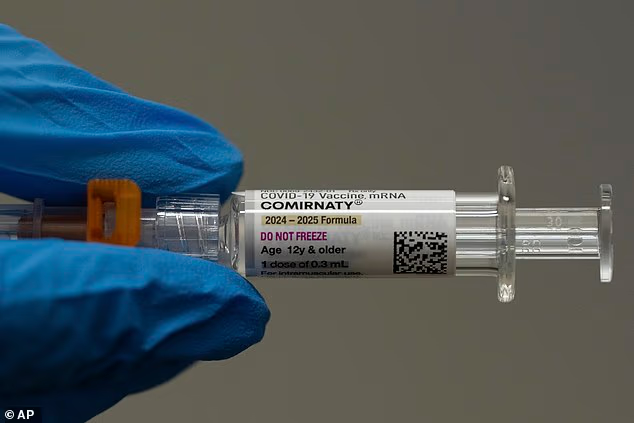
A group of scientists has found that Pfizer’s COVID-19 vaccine might raise the chances of eye problems that could lead to vision issues.
The new research focused on the cornea, which is the clear front part of the eye that lets light in so we can see.
Researchers in Turkey checked how the vaccine affected 64 people. They looked at changes in a part of the cornea called the endothelium—the thin inner layer—before the first vaccine shot and two months after the second one.
They found that after two doses of the vaccine:
- The corneas became a little thicker.
- There were fewer endothelial cells.
- The sizes of these cells varied more than before.
These small changes show that the vaccine might make the endothelium slightly weaker for a short time.
However, none of the people in the study had clear vision problems during that time.
For people with healthy eyes, these small changes probably won’t affect vision right away.
But if the changes last for a long time, they could cause swelling or cloudy vision in the future—especially for people who already have eye issues or who had a cornea transplant in the past.
A thicker cornea and fewer cells could lead to problems like corneal edema, bullous keratopathy, or corneal decompensation, which can cause lasting vision loss if not treated.
The scientists said in the report, which came out Wednesday in the journal Ophthalmic Epidemiology, that “the endothelium should be closely watched in people with low cell counts or those who had corneal graft surgery.”
Eye doctors can use a tool called specular microscopy to find out if someone has a low number of endothelial cells.
If you’re having blurry vision or discomfort in your eyes, this test can check if your cornea cells are healthy.

Having a low number of these cells can be caused by getting older, eye diseases like Fuchs’ dystrophy, eye surgeries, infections, or injuries. These cells are important because they help keep your cornea clear—and they don’t grow back.
In the study, the team found that after vaccination, the thickness of the cornea changed from 528 to 542 micrometers (about 0.0208 inches to 0.0213 inches). That’s about a 2% increase in thickness.
A slightly thicker cornea is not always dangerous. It can happen for a short time due to inflammation, fluid buildup, or pressure on the endothelium caused by minor sickness or eye injury.

But if it stays thick for a long time, it could make the cornea less clear and hurt your vision.
The scientists are not telling people to avoid getting vaccinated, but they said more long-term research is needed to know if these effects last beyond a few months.
The average number of endothelial cells dropped from 2,597 to 2,378 per square millimeter in the study. That’s an 8% loss.
Normal numbers for these cells are between 2,000 and 3,000 per square millimeter for healthy adults, so 2,378 is still in the normal range for most people.

But for someone who already had a low count—maybe from surgery or disease—losing more cells could be more serious for their eyesight.
The scientists also found that the cells became more uneven in size. The variation in size rose from 39 to 42. This means that when some cells die, nearby ones stretch to fill the space, which can lead to bigger size differences.
That may show the endothelium is under stress. If this keeps happening for years, it could make the cornea less clear.

The team also saw that fewer of the cells kept their normal six-sided (hexagon) shape—dropping from 50% to 48%. Healthy cells usually have this shape because it helps them stay packed tightly, like honeycomb.
Even though a 2% drop doesn’t mean serious damage, it may show the cells are reacting to some kind of stress from the vaccine over two or three months.
The researchers said that their findings suggest the changes were very likely caused by the vaccine—not just a random event.

If signs of swelling or stress go away shortly after the shot, then the effects may not be very harmful in the long run.
To do this study, the scientists examined 128 eyes (64 people), checking them before vaccination and again about 75 days after the second Pfizer shot.
They used a machine called Sirius corneal topography to check the cornea’s thickness and shape. Another tool, the Tomey EM-4000 specular microscope, was used to take close-up pictures of the cells to count them and see their size and shape.
Each person also had a full eye checkup, including vision tests, eye pressure checks, and scans of the front and back of the eye to make sure they were healthy.
By comparing the “before” and “after” results, the scientists were able to see if the Pfizer vaccine had any effect on eye health.

This new information adds to other safety warnings connected to Pfizer’s COVID vaccine that have been pointed out by the Trump Administration.
Earlier in May, the U.S. Food and Drug Administration (FDA) made Pfizer and Moderna update their warning labels. The new labels talk about possible heart-related problems caused by the vaccines.
Before, the vaccine labels only warned about a rare risk of myocarditis (heart muscle inflammation) and pericarditis (inflammation of the sac around the heart).

Now, the new warnings highlight that young men aged 16 to 25 seem to have the highest risk for these rare problems.


