Can Former Astronomer CEO Andy Byron Sue Coldplay? Lawyers Weigh In on Viral Concert Controversy
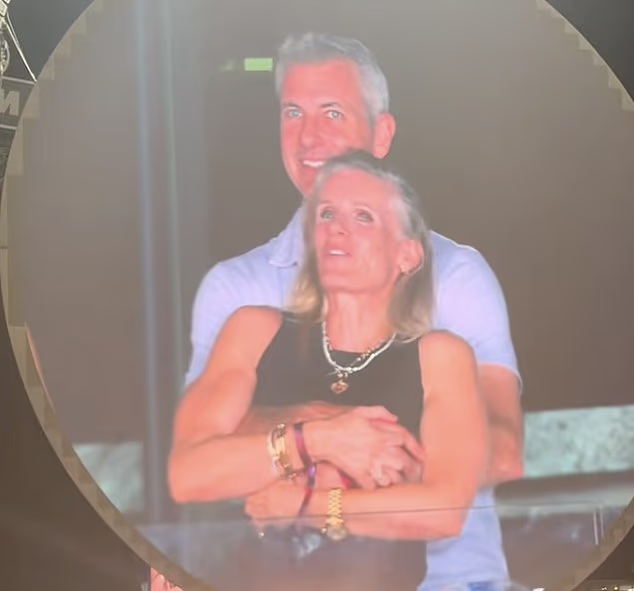
A apparently insignificant incident at a Coldplay show in Massachusetts on the evening of July 16 kicked off a viral chain reaction that would affect one prominent tech executive’s career.
During the presentation, Andy Byron, who was the CEO of Astronomer, a software business at the time, was spotted hugging Kristen Cabot, a female coworker.
https://platform.twitter.com/widgets.jsAs stated previously, Astronomer is committed to the values and culture that have guided us since our founding. Our leaders are expected to set the standard in both conduct and accountability, and recently, that standard was not met.
— Astronomer (@astronomerio) July 19, 2025
Andy Byron has tendered his resignation, and… pic.twitter.com/aTTUhnnyVz
Fans recorded the touching moment, which was aired live on the enormous jumbotron at the event, and it swiftly went viral on TikTok and other social media sites.
The video received millions of views in a matter of hours and ignited a heated online discussion on leadership behavior and accountability in addition to workplace limits.
The outcry on the internet was quick and severe.
Given the alleged power dynamics between Byron and Cabot, many viewers criticized Byron’s public expression of affection for appearing unprofessional.
Others questioned if the time was unsuitable at all or if it was just bad timing in a time of constant scrutiny.
But in a matter of days, the repercussions became evident.
Following the widely shared incident, Astronomer issued a public statement confirming Byron’s resignation.
As previously mentioned, Astronomer is dedicated to the principles and culture that have governed us since our establishment.

Our leaders are supposed to set the bar for responsibility and behavior, yet recently, they failed to do so.
The business also announced that Byron’s retirement had been approved by the Board of Directors and that Pete DeJoy, the cofounder and Chief Product Officer of Astronomer, would serve as interim CEO while a permanent replacement is sought.
Although it didn’t specifically identify Cabot or go into detail about any disciplinary action taken against her, the statement did highlight the company’s continued dedication to professionalism.
Many started to wonder if Andy Byron could sue Coldplay for airing the incident that may have been the catalyst for his career collapse as rumors about the aftermath persisted.
According to legal authorities, the answer is unquestionably no.
Prominent employment lawyer Ron Zambrano of West Coast Employment Lawyers was direct in his evaluation.
Zambrano informed The Mirror that “any legal claims from Byron would be dead on arrival.”
“He has no legal basis for a lawsuit.
First of all, it would be instantly overturned as a limitation on the right to free speech and the artistic freedom of Coldplay while performing.
Second, as soon as Byron and Cabot went to a public event, they gave up any expectation of privacy.
They, not Coldplay, are the object of their public show of adoration.
They were just apprehended.
Additionally, Zambrano pointed out that courts frequently maintain robust First Amendment protections for artistic expression and live performances, especially in situations when attendees are aware that they might be filmed or shown on big screens.

Tre Lovell of The Lovell Firm, a civil and entertainment lawyer, had a similar opinion.
You don’t have the right to privacy for what you do when you’re in public.
You are open to being photographed and filmed.
Although there are rules that protect people from defamation and the unlawful use of their image for commercial purposes, including advertising, Lovell explained that those prohibitions do not apply in this case.
“What individuals cannot do is utilize that footage to portray you in a misleading or defamatory manner or to breach your right to publicity, such as making money off of your picture.
However, nothing about this circumstance is acceptable.
To put it another way, Coldplay, the people who planned the event, and everybody who recorded the jumbotron moment probably acted perfectly legally.
As part of the entertainment experience, live concerts usually feature large-screen broadcasts of the audience, and venue advertising and ticket terms generally mention that attendees may be filmed.
The artists and production teams are legally protected by these disclaimers from allegations of image abuse or violation of privacy.
Furthermore, legal experts contend that emotional distress alone would not be sufficient justification for a lawsuit—especially not against a musician or event host merely practicing for a concert—even if Byron felt embarrassed or hurt by the public response.
Kristen Cabot has also been silent, and Byron has not yet issued a personal statement either the incident or his resignation.
However, social media is still analyzing the video and the wider ramifications of public responsibility in the digital era, indicating that online debate has not slowed down.
In a time when almost every public area doubles as a stage, the entire episode offers as a case study of how private moments may turn into public spectacles.
Legal experts think Byron has no strong case against Coldplay, despite the fact that he may have lost his job.
The band didn’t falsify the facts, make money off of his reputation, or disparage him.

They just aired what was taking place in front of them.
The most enduring effects might ultimately be reputational rather than legal.
And that can do more harm than any lawsuit in the rapidly evolving fields of technology and media.