The Controversial Episode That Took Off The Air

Married with Children, which was already well-known for stretching the bounds of comedy humor, found itself embroiled in one of the largest scandals in television history in 1989.

At the heart of it all was an episode called “I’ll See You in Court,” which was directed like any other episode of the show and written by controversial author Katherine Green.
On the surface, it appeared to be another Bundy-style mishap: Al and Peg Bundy, fed up with their domestic life, sneak away to a budget motel in an attempt to reignite their passion.
They were surprised to learn that the motel room’s concealed cameras had discreetly captured their private moment 📹.
The episode then abruptly changed course, revealing the couple’s response and culminating in a legal dispute in which the Bundys—along with another couple—attacked the motel for violating their privacy.
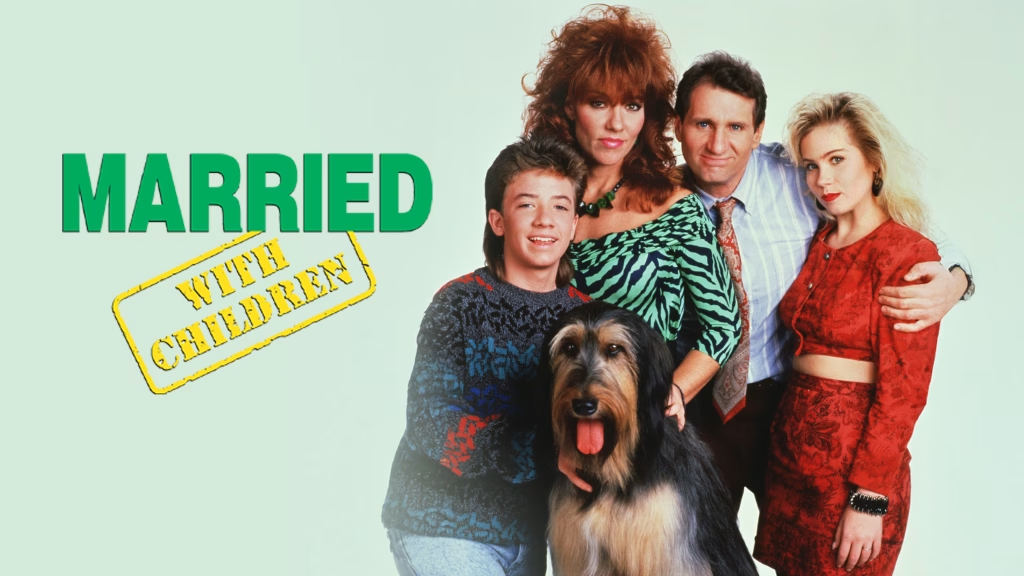
Even if the idea was humorous, the way it was carried out was much more controversial than what viewers of television were accustomed to at the time.
Sexually provocative remarks, adultery references, and risqué wording that straddled the boundary between edgy comedy and graphic content were all prevalent in the discussion.
It was unusually frank for a primetime sitcom in 1989.
Fox executives began to worry, but when information about the show leaked, the big storm came.
Almost instantly, conservative organizations and family advocacy groups jumped in 🚫.

They claimed that the episode made it difficult to distinguish between soft-core pornography and sitcom humor, which is particularly concerning given that Married with Children aired in the early evening when families would be viewing together.
Moral watchdog organizations made public declarations, parents started mailing letters, and soon after, advertisers threatened to revoke their sponsorships.
The danger was too high for a fledgling network like Fox, which was still battling to compete with ABC, CBS, and NBC.
Fox put the episode on hold and declined to broadcast it in the United States, even though production was already finished.
The choice brought to light the conflict between artistic independence and commercial viability ♼️.
The show’s creators felt constrained, claiming that Married with Children had never been promoted as a family-friendly show but rather as a sardonic, edgy substitute for the corny sitcoms of the 1980s.
In response, proponents of the termination said that the network had an obligation to shield viewers from what they considered to be offensive material.
The consequences didn’t stop there.
Critics such as Terry Rakolta, a Michigan activist who notoriously fought against the show’s crass humor, had already criticized Married with Children.
Following the “banned episode” event, Rakolta’s coordinated protests grew more intense, making national headlines and attracting even more attention to the show 🔥.
Paradoxically, the criticism served to increase Married with Children’s appeal.
As ratings increased, the show solidified its status as Fox’s first major hit, spanning 11 seasons and permanently altering the sitcom comedy scene.
The fact that the notorious episode was “lost” further piqued fans’ interest.
It was unseen in the US for more than ten years, discussed in fan communities, and traded as a piece of TV folklore 👀.
It’s interesting to note that in certain nations, where broadcasters were less worried about its content, it did air abroad.
It wasn’t until 2002 that “I’ll See You in Court” was eventually aired by cable’s FX network as part of a late-night syndication package that American fans had their opportunity.
Later, it was included in DVD compilations, allowing viewers to finally determine whether the outcry was warranted.
The unaired episode’s plot is now a part of Married with Children’s history.
It serves as a reminder of how television norms change over time and how something that was once deemed scandalous may now be seen as mild in contrast.
Beyond mere information, it captures a cultural moment when television comedy pushed the envelope, igniting discussions about accountability, censorship, and creators’ freedom to experiment 🎭.


