The Horse That Refused to Die: The Untold Story of Comanche, Survivor of Custer’s Last Stand

The Horse That Refused to Die: The Untold Story of Comanche, Survivor of Custer’s Last Stand
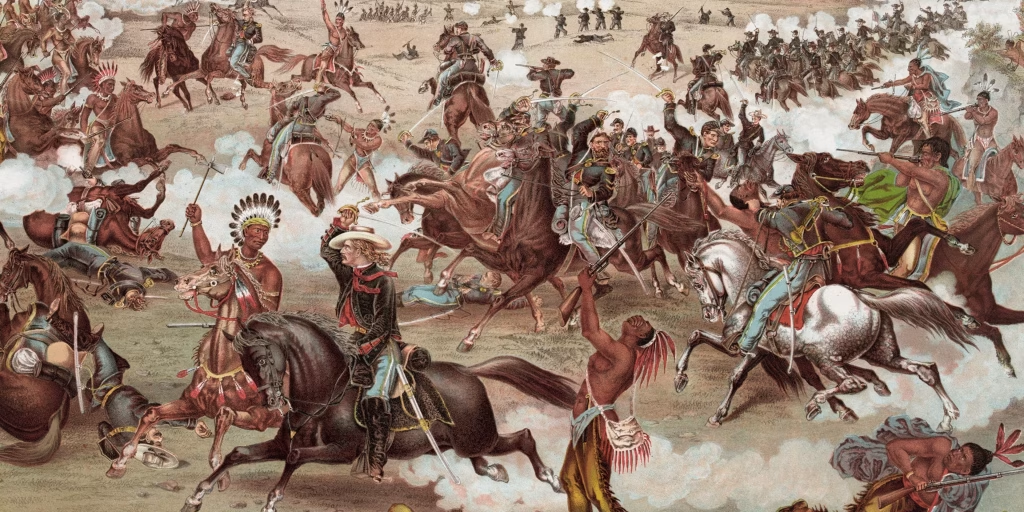
On June 25, 1876, the Montana plains were smeared with blood and the sky was darkened by smoke.

One of the most notorious conflicts in American history is still the Battle of Little Bighorn, often known as Custer’s Last Stand.
Hundreds of horsemen were killed. Whole businesses vanished from the world. With his troops surrounding him and arrows piercing the ground like ruthless exclamation marks, General George Armstrong Custer lay dead.
But something stirred in the slaughter’s quiet.
A quivering shadow. A survivor who nobody anticipated.
Not a soldier. Not a general.
The One They Were Unable to Kill
He was a dark-coated bay gelding with a proud demeanor that didn’t seem appropriate in the midst of the slaughter. He was a man named Comanche, and he often carried men into battle.

Comanche did not look away when the gunfire shrieked and the arrows showered. With his muscles strained and his hooves thumping, he thundered into turmoil and carried his rider toward the conflagration.
However, there was no way out of the chaos of Custer’s Last Stand. One by one, the cavalrymen fell. Screams reverberated throughout the valley. Unstoppable and determined to retake their territory from a nation of invaders, the Lakota, Northern Cheyenne, and Arapaho warriors closed in.
Almost all of the men under Custer’s direct command had perished by the time the dust settled.

Comanche, however, remained upright.
Never that, not unscathed.
Bullets had pierced him. sliced by arrows. Blood ran smooth across his hide. The weight of his wounds made his body shake.
He did not, however, pass out.
He stayed somehow, impossible.
The Finding That Astounded the Troops
When American forces searched the battlefield a few days later, they anticipated nothing but fatalities.
And they discovered that. Bloated in the sun, bodies were strewn about. Like a curse, the stench of decay rose.
Then— motion.
Stumbling, barely standing, a horse.
Comanche was the one.
Weary. destroyed. Still alive, though.

The soldiers came over in shock. This creature had been through the same hell that destroyed men, but it refused to submit. They had the option to put him down, put an end to his pain, and bury him beside the others.
However, they didn’t.
More was required of Comanche for some reason.
After being returned to Fort Lincoln, the Nursing of a Legend Comanche was saved by weeks of labor by surgeons and caregivers. His body was marred by seven wounds, some of which were severe and some of which were almost lethal.
Soldiers observed his daily struggles to breathe, stand, and eat. He refused to give in every day.
Slowly, amazingly, he recovered.
And a story began as he recovered.
Comanche was more than simply a cavalry horse now. He became into a symbol, something more. A living tribute to perseverance, loyalty, and the unsaid agony of those forced into conflicts they did not choose.
Never Again Be Ridden
Following Little Bighorn, Comanche’s destiny was irrevocably altered.
He was never mounted for combat again. Ordered into the thunder of gunfire never again.
Rather, he was treated as a distinguished visitor and took part in parades and celebrations in silence. His presence spoke more than any general’s words as he marched while wearing cavalry colors and concealing his scars under flags.
He was more than a horse to the men. He was the last person left alive after a massacre. A reminder of adversity and fortitude.
He eventually turned into a legend.
Not Just a War Horse
Generals are remembered in history. Their names are etched in stone by it. Comanche, however, was unique. He was not an egotistical or strategic individual. He was not a leader whose choices condemned others to death.

Despite being an animal caught up in humanity’s conflict, he lived longer than any of them.
It took more than luck for him to survive. As if nature itself required at least one witness to survive, it was defiance.
Imagine a battlefield filled with bodies withering in the heat, a lone horse refusing to lie down, and silence but for the wind.
A nation’s imagination was etched with that image.
The Legend Spreads
As the news got out, the Comanche became something unique, a mythical creature who transcended flesh and bone.
Newspapers referred to him with awe. Veterans cited him as evidence of fortitude, tenacity, and even divine intervention. Youngsters were told about the “horse that survived Custer.”
He was appointed the Seventh Cavalry’s “Second Commanding Officer.” He ate apples and grains. He was regarded as a soldier rather than as livestock.
The truth, however, remained straightforward beneath the ceremony: Comanche was merely a horse that resisted death.
The story was all the more eerie because of its simplicity.
A Legend’s Death
Comanche lived as a mascot for almost fifteen more years, never working but always being paraded. His body slowed and his coat grayed as he aged with dignity, but his tale only got bigger with each recitation.
He eventually passed away from disease in 1891. He passed away peacefully, surrounded by caregivers who had long before ceased viewing him as an animal and began to regard him as kin.
However, Comanche’s adventure did not stop at the ground.
His remains were kept, taxidermied, and put on exhibit at the University of Kansas, where they are still visible today as a relic, a glass ghost, and a reminder that sometimes the most reliable historical witnesses are completely silent.
The Unanswered Questions
What makes us think about Comanche?
Since he was the sole survivor of a massacre? because he came to represent the fidelity of the cavalry? Or because the thought that an animal silently bore the scars from the atrocities that men inflicted upon one another haunts us in our deepest recesses?
Comanche makes us face things we’d prefer to ignore. In addition to killing soldiers, the war obliterates everything in its path. that sometimes survival is a burden rather than a victory. Even people who were never given an option can be loyal.
The Quiet Eyewitness
Comanche should have been forgotten in the vast scheme of things. On that battlefield, he ought to have perished without a name, a mere victim lost to the passage of time.
However, he wasn’t.
Because sometimes politicians and generals do not own history. Sometimes it belongs to the survivors who have nothing to say, no speeches, no plans, just the unwavering determination to live.
Beyond being a military horse, Comanche was more.
He served as a reminder.
That endurance is possible even in the face of blood and destruction. that the person who endured honor rather than the one who sought it is occasionally the last person standing.
And despite all of its bloodshed, that history still contains tales of survival, love, and loyalty, even if they are told on four legs.
You, too?
That leaves you, the reader, with this question.
Will Custer, whose conceit drove soldiers to their deaths, come to mind when you think of the Battle of Little Bighorn? Or will you remember Comanche, the horse that was named for his endurance rather than his strategy, ego, or hatred?
Since the most enduring people in history aren’t always human, this may be the true lesson.
They are quiet at times.
They can get scarred at times.
Horses that refuse to die can occasionally be found.


